Atlanta Canopy Coverage 45.5% – 2023 UTC Report is Released
The rate of tree loss in the City of Atlanta is accelerating. Atlanta’s latest tree canopy report shows the city’s tree canopy cover decreased to 45.5%. Atlanta is losing about half (.43) an acre of tree cover every day.
The latest analysis of the city’s urban tree canopy (UTC) coverage uses 2023 data. A summary was presented to the City Council Community Development/Human Services (CDHS) Committee on August 11, 2026, followed by a report from the Arborist Division the first six months of 2026.
Click to access interactive maps and full report. Look up your NPU, City Council District, neighborhood, and specific blocks by address, plus watersheds and more.
New Patterns of Loss and Gain
The city’s first canopy study used 2008 data. That baseline year showed Atlanta had a tree cover of 47.9% of the total land area. The latest study uses data collected in 2023 and shows the same area decreased to 45.5% tree cover. The loss of 2.4 percentage points means a loss of more than 3 square miles of tree cover.
Atlanta City Council set a goal of no net canopy loss with a target of reaching 50% tree canopy cover; however, data show the rate of loss is increasing over time:
- 13 basis points UTC loss each year over 6-year period 2008-2014
- 15 basis points UTC loss each year over 4-year period 2014-2018
- 20 basis points UTC loss each year over 5-year period 2018-2023
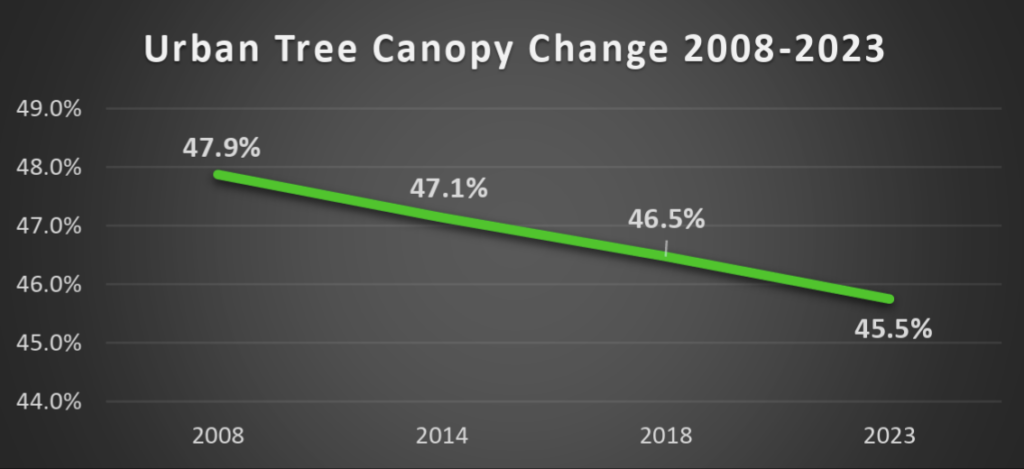 Graph from Canopy Study presentation to City Council, 8/1//26; comparisons uses 2008 city boundaries. The city annexed new land since the first canopy study in 2008. If the additional land area is calculated in the 2023 canopy measurement, there is 45.7% canopy within the new city boundary because the annexed additions were heavily forested areas.
Notable
A new leading cause of tree loss emerged in the 2023 report: development of multi-family housing, mixed-use, or clustered single-family housing. In earlier canopy studies of Atlanta, the biggest category of canopy loss was the cumulative effect of trees removed lot by lot for single family residential infill developments where much larger houses were built out to the maximum allowed size on lots.
- The greatest loss of large, contiguous forested tracts continues to be new industrial developments where clear-cutting is permitted.
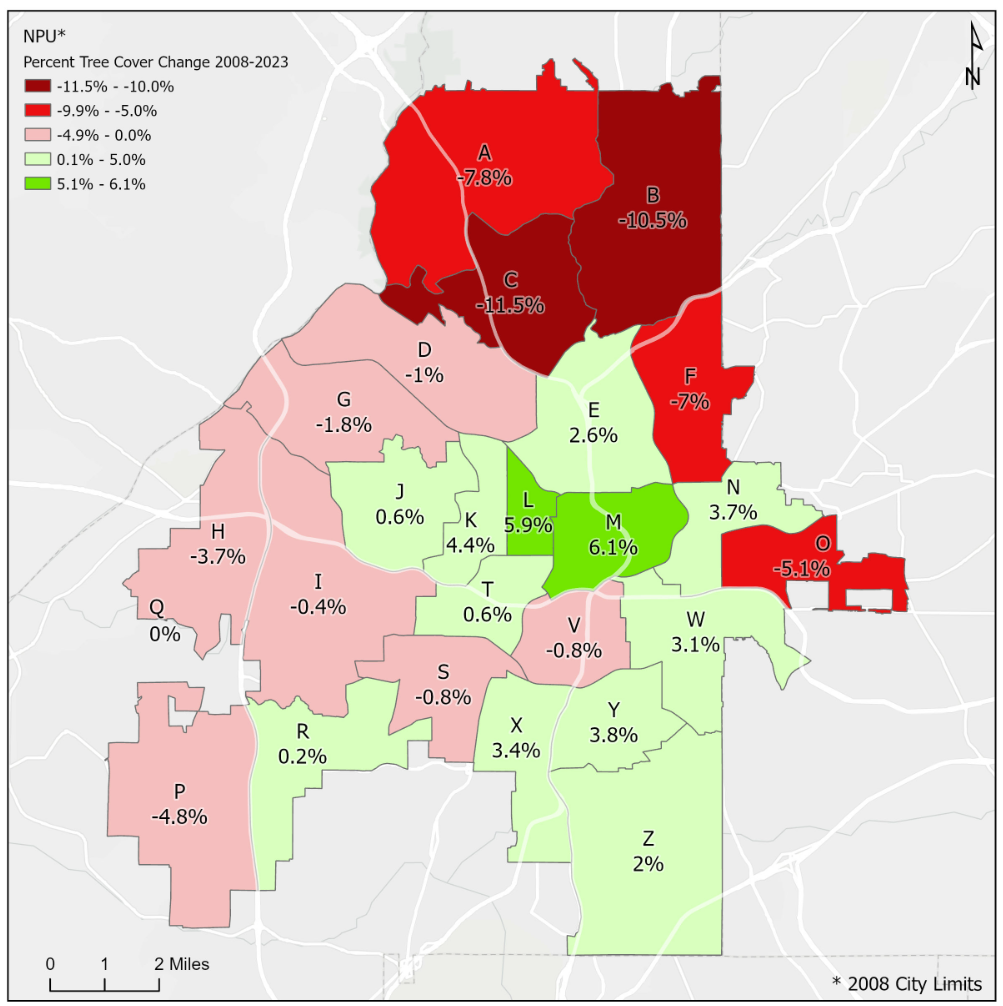
- Between 2018 and 2023, canopy change varies greatly across the city, with a majority of loss coming from the west, east and southwest, primarily due to an increase in multi-family developments.
- The vast majority of areas showing loss of canopy between 2018 and 2023 are located in the eastern, western and southwestern parts of the city.
- Multi-family development was the most common cause of loss, followed by single-family redevelopment and construction of new developments (single and multi-family housing, industrial, mixed use, institutional and commercial).
- Much of the significant canopy growth observed between 2018-2023 was actually regrowth of forest on lands cleared for development but left undeveloped or partially developed (Pipe Farms) and, regrowth on former Atlanta Housing Authority sites that have been demolished yet remain undeveloped.
- There was also significant canopy growth observed in younger street trees and neighborhood trees planted in single-family neighborhoods and multi-family developments constructed 10 -20 years ago.
- City parks make up approximately 5.1% land in the city and contain approximately 7% of the city’s tree canopy. The average tree canopy coverage on park land (54%) is slightly higher than the city’s overall tree canopy coverage.
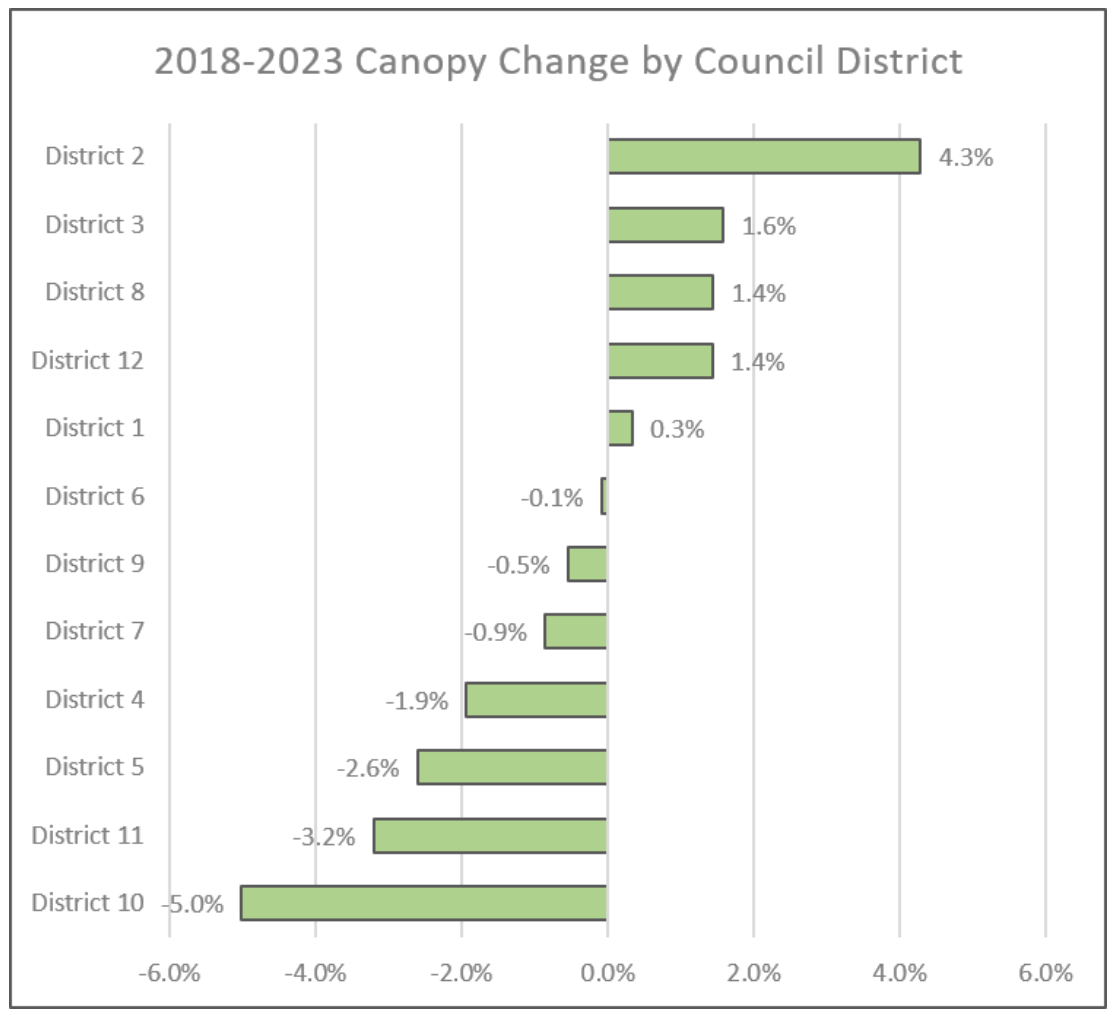
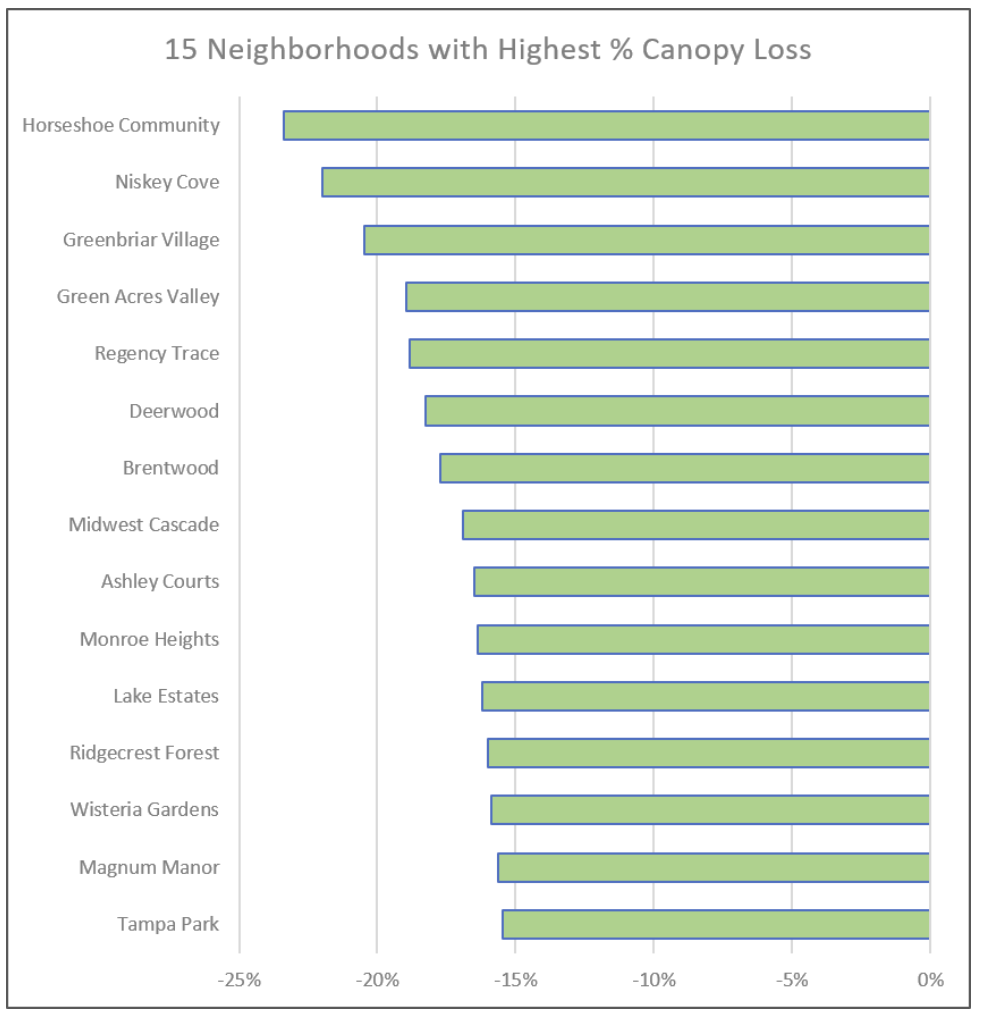
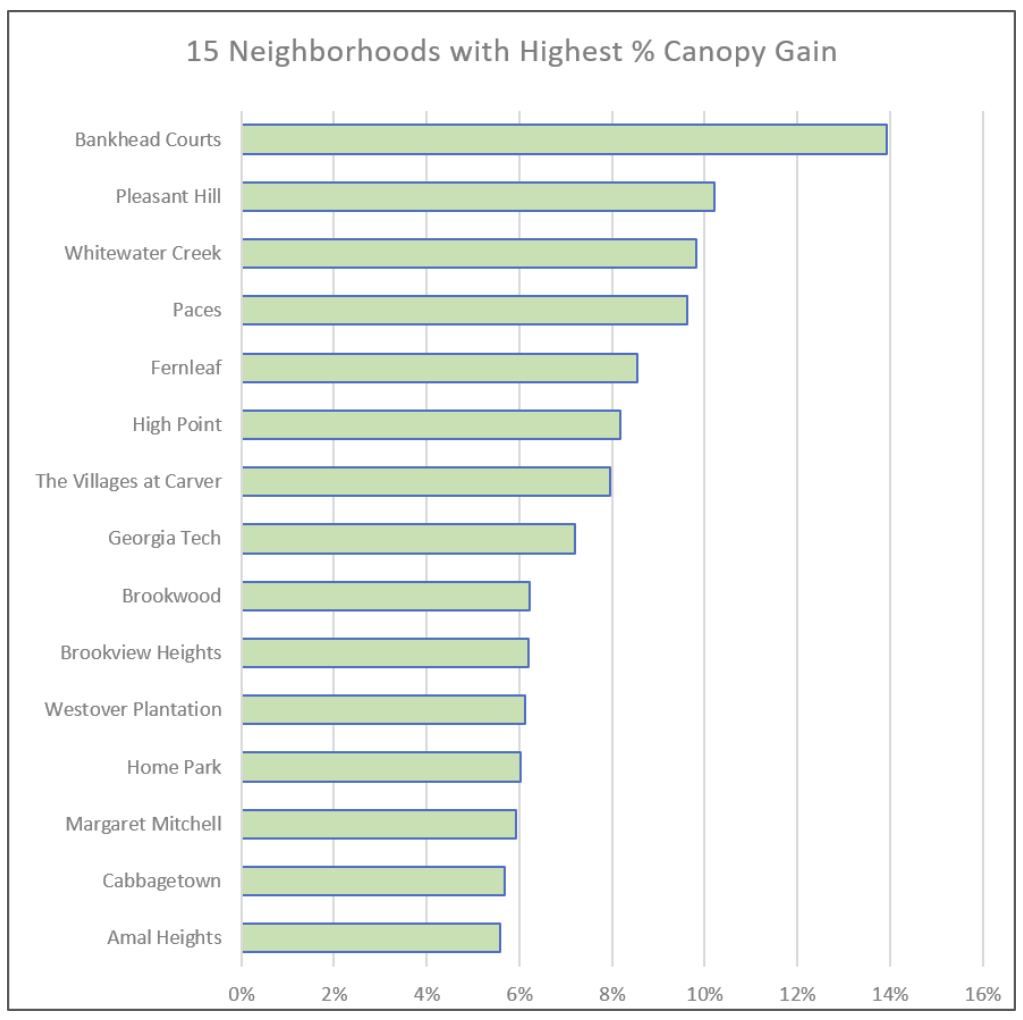
The interactive tool provided by the study author provides extensive data including percentage of tree gain or loss by NPU, District, and neighborhoods, as shown below.
Uncertain Impact of Approved Updates to TPO
The effectiveness of the updated TPO will be an increase of overall tree canopy cover and decreased canopy loss. It is unclear based on the city’s report of tree permit activity for the first six months of 2026 whether there has been an effect on tree loss and/or gain.
Updates to Atlanta’s Tree Protection Ordinance (TPO) were adopted in phases: Phase 1 (2023) and Phase 2 (2025), which included improvements to tree planting specifications, increase in the fee for tree recompense, and other administrative changes. Updating tree preservation standards were not included and is considered a significant remaining goal for further updates, i.e., Phase 3. Meanwhile, it’s uncertain what the impact of the Phase 1 and 2 updates have had. Phase 2 updates went into effect January 2026 (with some “grandfathered” permits from earlier applications). The canopy report only shows the state of the city’s trees as of 2023.
According to David Zaparanick of the Arborist Division, the next steps for continuing work on the TPO will happen “behind Zoning 2.0” in order to follow zoning standards that will be set. Councilmember Kelsea Bond asked, “why do we need to do them back to back like that?”
A significant driver of tree loss is related to development and land use which is specified by the zoning code.
We have an opportunity to use the tree canopy analysis and study the patterns of tree loss and gain. They are largely controlled by development patterns. Oversight and management of zoning and tree protection both fall under the Department of City Planning. The two code updates should inform and influence the other to produce the most beneficial outcomes for the community overall, including environmental, health, and social impacts.
For example, the 2023 report reveals significant canopy gains are from street trees. While the majority of the city’s canopy remains on single family residential properties (72%), the presence and growth of right-of-way trees are immediately beneficial and add incremental canopy growth. The specifications and enforcement for tree planting space on the streetside as well as within the development lot is determined by the zoning code. Per the canopy report: “urban tree canopy coverage is driven by land use.”
Protect and Grow the Canopy
Here’s what can be done now to mitigate the further decline of Atlanta’s valuable tree infrastructure. Trees Atlanta advocates for:
- Adopting stronger tree preservation standards (i.e., Phase 3 TPO updates)
- Acclerating the purchase of the few remaining large forested spaces for permanent conservation
- Supporting the enforcement of the TPO
- Working with individuals, businesses, and community to maximize tree planting on private property
Strategies to protect forested spaces, such as the recent acquitions of Lake Charlotte Nature Preserve, Lucinda Bunnen property, and others, have put hundreds of acres of canopy into permanent conservation. Protecting these large areas of mature trees provide tremendous environmental and health benefits to the city, as well as more recreational access.
Consistent, intentional efforts planting in neighborhood streets are adding needed canopy accessible to the public. Focused projects, such as the Downtown Tree Planting initiative has increased the canopy of downtown from 3% in 2008 to more than 9.21% in 2023.
Watch the August 11 Presentations to City Council CDHS
This analysis is from the fourth study of the city’s tree canopy lead by Tony Giarrusso, Professor at Georgia Tech School of City and Regional Planning, for the City of Atlanta. Professor Giarrusso provided a brief summary of the findings to the CDHS committee on August 11.
- Video recording of Professor Giarrusso’s presentation to the CDHS committee, available on ATL26 or Youtube.
- PDF of the 2023 Canopy Study presentation slides
- Full report – 2023 City of Atlnata Canopy Study
- Interactive maps, additional data, plus previous reports
After the brief summary of the canopy report and questions from the committee, CDHS Chair Matt Westmoreland introduced David Zaparanick and Kathy Evan from the Department of City Planning, Arborist Division, “to tell us about how the first 6 months of our new TPO has gone.”
- Video recording of the Arborist Division’s TPO Update, available on ATL26 or Youtube.
- PDF of the Arborist Division’s TPO Update
Published on August 13, 2026


