Conservation for Bigger Impact: One Million Trees Initiative Year 4 Progress Report
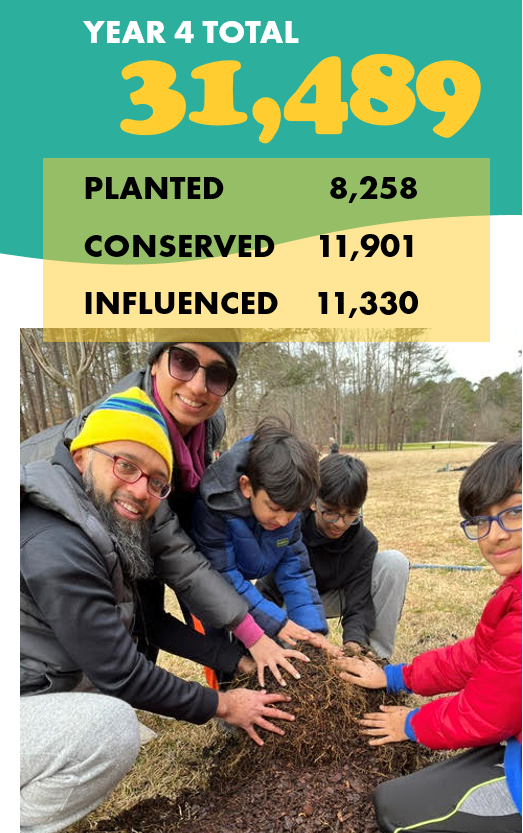 The total count of OMTI trees in Year 4 is 31,489 trees. This brings our tree count to date to 146,385 trees for the One Million Tree Initiative (OMTI).
In Year 4, there were 8,258 trees planted, 11,901 trees conserved, and 11,330 influenced trees.
To date (years 1 to 4), 34,614 trees planted, 85,149 trees conserved, and 26,622 influenced trees.
OMTI is a collaborative effort that challenges the participating partners to reach our 1,000,000 tree goal by 2030. Every OMTI partner understands that trees are a critical natural green infrastructure solution that is a important part of every community’s ability to improve its climate resilience and the ability for humans and animals to thrive in the future. This is a voluntary initiative that aspires to amplify and activate efforts that will increase the tree canopy in our cities.
Trees planting efforts by the OMTI partners are the most visible and familiar actions; however, it is by far the most limited of the three strategies to reach the million tree goal. Influencing a large number of people in each of the partner networks can leverage the collective power of communities, especially by collaborating with our retail partners who can offer more native trees in their marketplaces.
The third and most powerful strategy is to protect large forested areas, saving thousands (or dozens) of trees all at once. We strongly advocate for accelerating more acquisition of forested areas for conservation as the most powerful strategy to ensure our trees stand for the health, well-being, and resilience of our communities.
Scroll down to read the report below or download a PDF of the Year 4 Progress Report.

Achievements
- Eight of the 13 OMTI Community Partners participate in the Trees Atlanta Yard Tree program, a popular option for residents to request free trees planted in their front yards. In Year 4, we planted 739 yard trees in Community Partner cities/county, up 29% year over year.
- Four forested parcels were acquired by two OMTI program partners in 2023. The city of Atlanta conserved 11,781 trees. The city of Brookhaven conserved 120 trees.
- The Atlanta downtown tree planting plan set a goal of 8,000 new trees for the lowest canopied neighborhood in the city: Downtown. With funding from the Inflation Reduction Act (IRA) grant through the USDA, Trees Atlanta accelerated planting in the city center, including extensive concrete cutting and removal to create new tree wells for planting.
Critical Importance of Conserving Trees
- Protecting and preserving existing trees where they stand is our most urgent and impactful strategy – large trees deliver the most benefits. Destruction of existing trees and forested areas eliminates benefits that typically cannot be replaced with new trees in the near term, or ever.
- Trees are highly effective natural resources and critical natural green infrastructure. More trees where more people live and work is an investment that allows cities to be better prepared for oncoming climate change.
- Decreasing the removal of healthy mature trees is an effective choice that can be implemented for immediate local benefits across metro Atlanta.
We Thrive When We Live and Work Near Trees
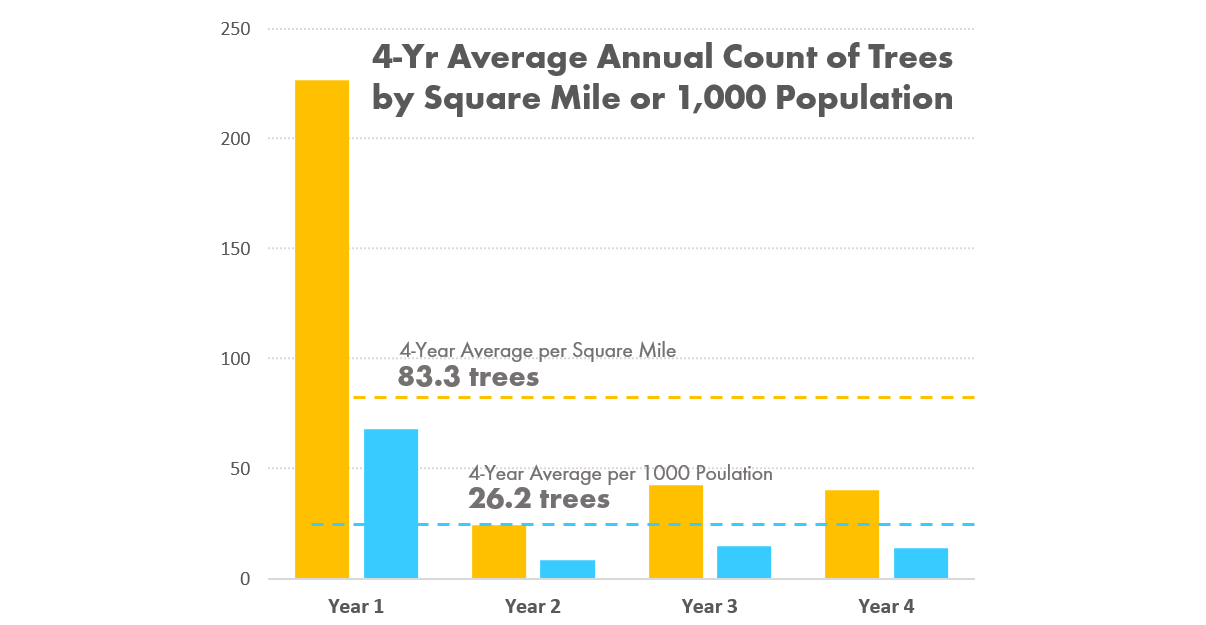
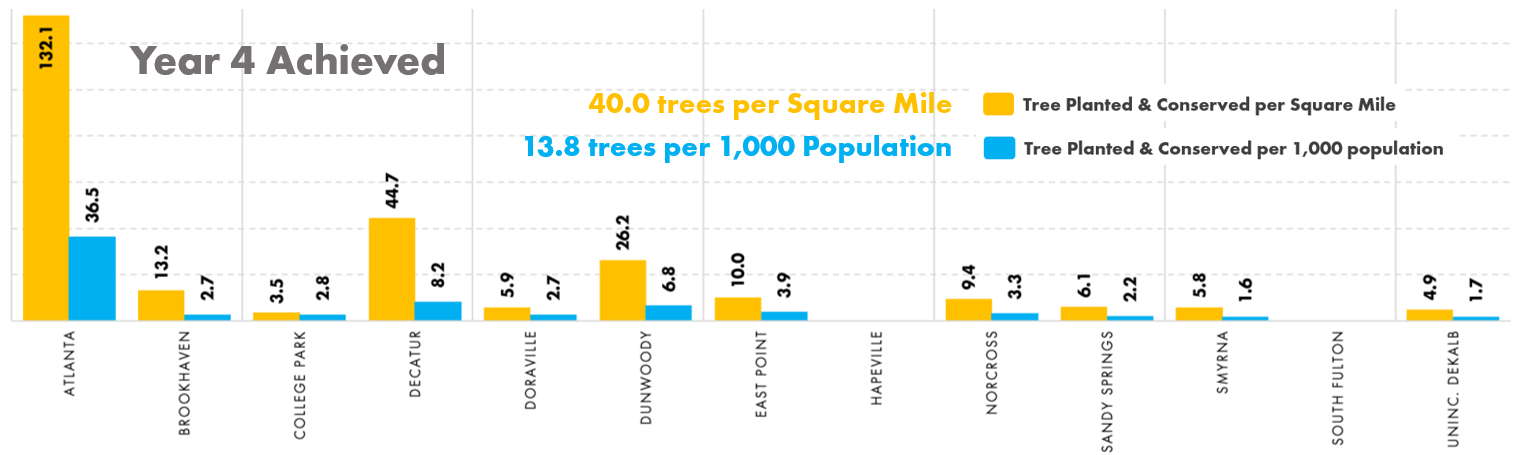
Trees on city streets and in neighborhoods where people live and work have the greatest benefit. Urban areas include residential neighborhoods, as well as commercial areas and city centers. The majority of people in Georgia (60%) live in these developed urban areas. Each OMTI Metro Partner represent vastly different land areas and population, so it’s useful to see a comparison of progress by these scales: 1) trees planted per square mile of land, and 2) trees planted per 1,000 residents.
- Conservation of trees represent the largest share of OMTI tree totals.
- Land acquisition with the purpose of preserving trees in forested areas is a recommended city planning strategy that offers permanent canopy protection and additional places to access and enjoy nature for residents and visitors.
- Metro Atlanta continues to be among the fastest growing metropolitans in the country with the population expected to reach 8 million by 2050 (according to Atlanta Regional Commission). Without intentional planning, cities will be challenged to balance smart growth with natural green infrastructure, especially trees, for the long-term health and environmental needs of our region.
- Atlanta, Decatur, and Dunwoody stand out on these measures with the highest investment in trees per square mile and per person.

Year 4 Observations
- Conservation of trees is the biggest contributor related to OMTI tree totals, as the number of trees saved far outnumber the number planted or influenced in all four years.
- The City of Atlanta has made progress on their efforts to preserve more trees by strategically identifying and purchasing densely forested land. A 2016 amendment to the city’s tree protection ordinance allowed the use of their Tree Trust Fund to acquire land, in addition to funding planting and education programs.
- A key partner in such land acquisitions has been a founding OMTI Community Partner, The Conservation Fund. The organization helps clients identify priority undeveloped parcels and acquires the land. The land is later purchased by the city for conservation.
- As the Atlanta region grows, intact forests continue to disappear. We encourage OMTI partners to allocate resources to preserving existing forests while they still stand. Planting and conservation work hand-in-hand to keep Metro Atlanta communities resilient.
- Conserving existing urban and suburban forests has a powerful, broad-based impact on the well-being of our communities. The environmental, health, and social benefits for people is a smart investment to leverage now. Decades of growth are lost when we destroy existing forests.
- Existing forests are already established and often include significant plant diversity and wildlife ecosystems. A mature tree saved is far more valuable than a new tree planted, in terms of carbon capture (in the tree and the undisturbed soil), air, water filtration, shade, and wildlife habitat.
- Becoming a Yard Tree program partner is a simple step to adding new trees to a city’s canopy. Tree survival and growth improves greatly when trees have access to more soil volume in front yards versus nominal planting spaces in street margins.
- Intentional efforts by OMTI Partners to educate their audiences and create incentives to protect and add trees in their own properties is imperative to elevate the importance of trees in all development and land use projects.
All OMTI annual progress reports can be viewed on the One Million Tree Initiative program page. For additional support, please email info@treesatlanta.org
Posted on December 19, 2024


