A Better TPO Can Be Had: Pass Phase 2 TPO, Keep Moving Forward
Call to Action:
1. Contact your City Councilmember and DCP Commissioner Jahnee Prince
Pass Phase 2 in June to keep moving forward on improving the TPO.
2. Plan to attend an upcoming public meeting.
Residents of Atlanta are permitted 2 minutes for comments (you must be signed in prior to meeting start time to be on the list of speakers).
Upcoming City Council Meetings you can attend at City Hall:
- Monday., 6/16/25 – Full Council meeting, 1:00 p.m.
===
Update 6/13/25
 Is there a new TPO?
On June 10, a new version of the Tree Protection Ordinance (TPO) 24-O-1691 was substituted, accepted, and approved by the Community Development/Health Services (CD/HS) Committee. Ordinances require a review and vote in committee before being sent to full City Council for a vote. This means the ordinance now advances to the full City Council. The City Council meets on Monday, June 16.
We believe City Council intends to vote on this TPO at the Monday session.
The City explained that key tree preservation improvements were withheld from the June 10 TPO so that further “testing” can continue and aligned with the Zoning code update. The June 10 document also contains errors and inconsistencies that should be corrected if the City Council intends to vote on Monday. In response to the June 10 TPO, Trees Atlanta sent to the City a short list of impactful changes (that do not infer with the sections being tested) and requested that they be updated to the TPO document prior to Monday.
Delay has allowed too many trees to be lost. Progress means taking steps forward.
Phase 2 TPO is a trust fall.
Trees Atlanta is calling this step Phase 2 TPO, following the precedent set with the passage of the Phase 1 TPO in 2023. Although the June 10 TPO lacks the better tree preservation requirements that the community asked for and is short of what the city needs for long-term sustainability, it may be the most practical next step. It’s not great, but it’s progress.
The City is asking Atlanta to take a trust fall: pass the TPO now and allow the city to continue testing the tree preservation standards for another draft later in the year. This is not the comprehensive improvement advocates had hoped for, but what we may have is an opportunity to take a step forward.
The TPO document does not include new tree preservation standards that have been in all prior versions. The City is holding this back for testing.
The TPO document also lacks an improved tree density requirement (the count of trees after construction) or a recompense fee that matches actual replacement costs. The TPO includes recompense waivers for developments that include affordable housing units. We feel strongly that no housing option should leave people without the benefit of trees, and recommend some trees be retained when affordable housing discounts are taken. These requirements can still be updated to the Phase 2 TPO because they are independent of the tree preservation standard being tested.
At the June 10 CD/HS hearing, Councilmember Bond questioned Commission Prince. Bond was “not happy” that the TPO did not include the tree preservation standard. In reference to the testing process that Commission Prince said was underway, Bond stated: “I’m going to put together a piece of legislation to track the progress of this and ask for a report of your department until this new ordinance is drafted in the coming year.”
Without better tree protection standards, we are not finished delivering a better TPO for Atlanta. We hope what follows Monday is continued work to improve tree protection for the health and well-being of the people of Atlanta.
What’s Next?
We are not sure what will happen at the Monday, June 16 City Council full session, but it’s likely the City Council will bring forth the TPO and vote on it. Phase 2 TPO can take us forward if the City is able to make the adjustments Trees Atlanta has submitted. They correct technical errors and inconsistencies and adjust discount structures so that they reward commercial developments that retain more trees and still allow market rate developers to receive the “predictable” fee structures they have asked for.
During this rewrite process, the stakeholders have rushed around unpredictable next steps. We request the City set and communicate a schedule for testing and set a deadline for the inclusion of tree preservation standards and other sections left out of Phase 2.
A phased approach may be the way Atlanta moves forward. A trust fall may be what it takes to make progress.
Summary of the June 10 CD/HS Meeting Outcomes.
Another “substitute” (a.k.a., new version) of the TPO (24-O-1691) was submitted and accepted at the June 10 meeting. Commissioner Prince of the Department of City Planning provided a brief summary of what was changed in the substitution. This document had not been publically circulated in advance. It was passed by the committee with 4 Yes votes, 1 No vote, and 1 Abstain.
(A recording of the June 10 meeting is found on the City’s YouTube Channel 26. See links below to view specific portions of the recording.)
At the committee meeting, two other ordinances that are related to the TPO were also accepted as substitute ordinances and approved by the CD/HS committee. One increased the funding amount to assist low income seniors with hazardous tree removal or pruning to $400,000, and the other created an optional arborist review of plans.
These are the three ordinances related to the TPO that were advanced to City Council.
24-O-1691 AN ORDINANCE BY COUNCILMEMBER MICHAEL JULIAN BOND AS SUBSTITUTED BY COMMUNITY DEVELOPMENT/HUMAN SERVICES COMMITTEE TO AMEND THE ATLANTA CITY CODE, PART II (GENERAL ORDINANCES), CHAPTER 158 (VEGETATION), ARTICLE II (TREE PROTECTION), TO ADOPT A NEW TREE PROTECTION ORDINANCE FOR THE CITY OF ATLANTA; AND FOR OTHER PURPOSES.
Substitute accepted and approved: 4 Yes; 1 No; 1 Abstain. (View the discussion)
- What is this? Ordinance 24-O-1691 changes each time a “substitute” document is accepted by the committee. The last publicly available document was the “substitute” introduced at the May 13 CD/HS committee meeting. Another substitute document was submitted at the June 10 committee meeting and approved by a 4 to 1 vote of the Councilmembers present. This ordinance is now available to be introduced at the next City Council meeting and considered for approval. The June 10 TPO excludes all tree preservation standards that had been in earlier versions, but it reintroduces discounts for developments that contain affordable housing. The document also contains some technical errors that we hope can be easily corrected before it is sent to the full City Council. Trees Atlanta is submitting corrections that we strongly encourage to be made.
- Is this a good change? It’s not great, but it’s progress. The city leadership are showing strong signals that they are impatient to pass “something”. That something might be this substitute. The TPO is incomplete without stronger tree preservation requirements, better tree density counts, recompense that matches market costs, adjusted affordability thresholds, and more.
Summary of changes in the substitute TPO according to Commissioner Prince (per her comments at the June 10 meeting):
- Increases low income senior assistance program to $400K paid from the Tree Trust Fund for removing or pruning hazardous trees
- Recompense reductions for single and multi family units AMI and % units affordable
- Raises recompense to $140 per inch
- Adds several staff positions: 3 Senior arborists and 6 Field arborists (50% funded by Tree Trust Fund (TTF) and 50% by general fund); Authorizes funds to pay for secretary for Tree Conservation Commission (TCC), project manager for TCC; adds a Sr. Arborist to Parks Department
- Gives option to public projects if they can’t meet inch per inch, then can do urban forestry projects, then payment of recompense
- Creates a Tree Registry program
- Offers homeowners assistance if they have issue with their homeowners insurance related to trees and will help with those communications
Commissioner Prince also reiterated that code enforcement is available on the weekends. She urged the audience to contact Weekend Code Enforcement at 404-330-6178. She added: “You’ll become part of our Tree Brigade to let us know when illegal cutting is happening.”
25-O-1341 AN ORDINANCE BY COUNCILMEMBER MICHAEL JULIAN BOND TO AMEND THE ATLANTA CITY CODE, PART II (GENERAL ORDINANCES), CHAPTER 158 (VEGETATION), ARTICLE II (TREE PROTECTION), TO REQUIRE THAT THE ‘ARBORIST MEETING’ TAKE PLACE AT THE INITIAL STAGE OF THE TREE PERMITTING PROCESS; AND FOR OTHER PURPOSES.
Substitute accepted and approved: 6 Yes; 0 No. (View the discussion)
- What is this? Ordinance describes a meeting with the city arborist at the start of the permitting process. Late text changes (“substitute”) made this meeting optional.
- Is this a good change? It’s an optional meeting, so this is not much of a change. The opportunity to participate in early construction reviews is already a part of the building permit process. We recommend that large projects take the time to carefully consider the TPO in the earliest stage of planning. A review with city arborists can clarify the ordinance and its requirements. Regardless of the ordinance, good planning should include designs that work around and with trees and at minimum comply with the TPO.
25-O-1099 AN ORDINANCE BY COUNCILMEMBERS MICHAEL JULIAN BOND AND BYRON D. AMOS TO ESTABLISH A PROGRAM FOR ASSISTANCE WITH TREE REMOVAL AND PRUNING FOR ELIGIBLE SENIOR CITIZEN HOMEOWNERS IN Community Development/Human Services Committee Page 7 Draft as of 6/10/2025 THE CITY OF ATLANTA; AND FOR OTHER PURPOSES.
Substitute accepted and approved: 6 Yes; 0 No. (View the discussion) Substitute increases budget to $400,000.
- What is this? This ordinance updates the provision in the Phase 1 updates to the TPO that created a $200,000 budget reserved to assist low income seniors remove or prune hazardous trees. This ordinance update increases the funding from the Tree Trust Fund to $400,000.
- Is this a good change? The purpose of creating the Tree Trust Fund (TTF) was for funding the preservation and planting of trees. Trees Atlanta supported allocating an annual fund to assist low income seniors. We are unaware that any funding has been used to date since it was added to the TPO in 2023, and are unaware why the budget has been increased to $400,000. The city has not published annual recompense income collected nor the current balance of the Tree Trust Fund making it difficult to evaluate whether these additional expenses can be supported by future recompense revenue along with existing and newly added expenditures.
Other materials you may find useful.
To follow the agendas of City Council meetings, you may view materials online
- CD/HS Agendas and Materials (current and past)
- Upcoming Meeting Agendas City Council meetings
Recent coverage.
Update 6/6/25
Current Status: At the May 13, 2025 meeting of the Community Development/Human Services (CH/HS) Committee meeting, another substitute ordinance for the TPO (24-O-1691) was introduced without prior public circulation.
As of today, the officially submitted TPO held in committee is the May 13 version. The May 13 document is dramatically changed: it has removed all tree preservation standards for single family residential and commercial properties, as well as accommodations for affordable housing developments.
Call to Action – Pass Phase 2 Updates in June: Trees Atlanta has shared our comments and recommendations to the City with the hope the Phase 2 updates can be approved in June. Approving Phase 2 updates do not hold back developer’s demand for further testing for tree preservation standards and affordable housing accommodations.
Approving Phase 2 updates keeps the City’s commitment to improve the TPO.
Phase 2 would include a new incentive to reduce clearcutting of existing trees on commercial developments, tree density (count of trees) required on properties after construction, recompense aligned with the true cost of trees, and a registry of tree professionals that will track and restrict repeated TPO offenders. Tree density requirements, schedule for increased recompense, and registry has been in all prior versions of the TPO. Trees Atlanta has shared details of our recommendations with the City. With these changes, the May 13 document can be ready for review by the CD/HS committee on June 10 and be on track for Full City Council consideration for approval on June 16.
Get Beyond the Delays: The deletions of the tree preservation standard and affordable housing accomodations were a response to vigorous pressure from the development community who said “further testing” was needed. This is a delay tactic; the development stakeholders have been present at every working group meeting for the past four years, and now are calling for “further testing” as the TPO was appearing to finally arrive at a vote. Commissioner Prince indicated that the Department of City Planning (DCP) wanted to align the TPO with upcoming Zoning updates. The Zoning update process has been ongoing for two years.
This is the third attempt to update Atlanta’s TPO. The first failed in 2014 due to prolonged delays to arrive at consensus. The second failed in 2018 due to prolonged delays to arrive at consensus. The third is at risk of being derailed again in 2025 due to more delay tactics. Delay and no change allows tree loss to accelerate.
Keep Moving Forward: The City has asked the public for an extraordinary level of “engagement” over these long years. We, the residents of Atlanta, have attended hundreds of meetings, including four years of the latest round. All the while, the effects of heat island temperature rise, extreme weather, and air quality continue to escalate while trees continue to disappear in Atlanta.
The City has abundant input and information from the community, and now it is time for them to make progress. Developers demand to keep tree recompense fees artificially low and keep benefiting from regulations that allow excessive removal of healthy trees. We need a better way to balance growth while protecting people’s health and wellbeing. We need an improved TPO for the public good.
Let’s keep moving forward and pass Phase 2 now.
Update 5/6/25
On May 1, 2025, the Department of City Planning and the City Council conducted a working meeting to review the most recent edits to the TPO. Following the meeting, DCP Commissioner Jahnee Prince distributed these documents:
- Overview of TPO substitution from May 1 working meeting, plus extra slides
- TPO Fact Sheet (dated 4/21/25)
- Redline Substitute TPO (dated 5/1/25)
3/29/25 update
TPO is expected to be heard at the April 29 (Tuesday) meeting of the CDHS Committee at City Hall (1:30 pm).
We have not yet received any feedback from the Department of City Planning (DCP) whether any of the recommendations that close notable gaps in tree protection will be considered and corrected for the committee to review at the April 29 meeting.
Although unconfirmed, DCP may be a considering removing portions of the key tree preservation and/or recompense requirements prior to April 29. Dismantling portions of the TPO (or delaying the TPO update once again) only serves groups that benefit from low barriers for tree removal. Trees Atlanta and tree advocates endorse that recompense and tree preservation updates are necessary and should be kept intact and not removed, and we urge DCP to close the identified gaps in tree protection while we have the chance to truly deliver a better TPO. Perfect should not be the enemy of the good, but the TPO is a legal document that needs specific language for effective enforcement. A short list of administrative process and protection oversights have been identified: this is the time to close the gaps and move forward. We are ready to pass a better TPO with these responsible corrections. Let’s move forward.
The DCP and CDHS committee, along with all members of the City Council and the Office of the Mayor, have be sent the short list of corrections with specific markups for their consideration (see below).
Urge our city representives to CLOSE THE GAPS and PASS A BETTER TPO.
Tree protection should be a decision based on science and good city plannning policies. Other major cities envy Atlanta’s rich resource of trees and are actively working to increase their own tree canopy cover. Atlanta has a valuable resource that can be quickly destroyed, but one that would take generations, if not centuries, to repair.
“Developers are going to develop.”
The March 25 CDHS meeting room was filled to capacity. Many individuals asked the Councilmembers to pass a better TPO.
To view a recording of the March 25 meeting:
- Jump to TPO agenda item with status update from DCP Commissioner Prince, ordinance sponsor CM Bond, and public comments for the TPO
- Jump to general public comments (addresses other items on the meeting agenda as well as tree protection)
3/24/25 update
The next CDHS Committee meeting of the City Council is scheduled for Tuesday, March 25 at 1 pm in Atlanta City Hall, 2nd Floor.
These meetings are open to the public, and Atlanta residents are invited to make public comments at the start of each meeting. The CDHS committee is responsible for working with the Department of City Planning to get the TPO updated. They review the TPO before it is brought to the full Council.
Urge the City Council to pass a better TPO. The Department of City Planning (DCP) can close the gaps in tree protection and deliver a better TPO to the City Council.
A complete mark up document has been sent to to DCP with specific language to close the gaps on tree protections. City Council repeated cites that they are “waiting” for the updated TPO, so if we have stakeholder input and we have ways to write a better TPO, why can’t we move forward?
Close these gaps in tree protection and pass a better TPO.
Detailed information has been submitted to the Department of City Planning (DCP) for these urgent corrections that are need to close the gaps in tree protection:
- Align recompense fees to actual cost of replanting trees
- Enforce tree preservation and tree density standards
- Cap the use of the Tree Trust Fund to 20% for expenses unrelated to tree planting, forest acquisition and restoration.
- Allow affordable housing to have relief from recompense equal to (but not higher than) the share of affordable housing provided by the development
- Protect trees in all wetland areas, including those outside of a stream buffer encroachment variance.
- Create an alternative for city projects to replace their 100% preplanting requirement with options that allows replanting and repayment. City projects must follow the TPO, including making all city permits appealable.
These are desired improvements to Atlanta’s TPO. To meet the city’s goal to preserve more trees and work toward reaching 50% canopy, it’s equally important to include measures to maximize replanting and conserving forests.
We need better protection to keep our trees, and we need the clear strategy and means to acquire forests while we still can and replant where ever feasible. As Atlanta continues growing, we need to keep both strategies to be central to Atlanta’s city planning.
Meanwhile, the city has fast tracked other legislation to move ahead and increase risks to trees.
- City Council approves Ordinance 25-O-1129 that bypasses the TPO and lowers tree replacement requirements for the city by 90%
- Department of City Planning moves to change zoning law to allow builders to move buildings closer to the property lines because of tree preservation standard in a TPO that has not passed yet (Administrative Zoning Variance Z-25-04)
Did you know that Atlanta has lost 2 square miles of tree cover since 2008? That’s like clearcutting all 120 acres of Cascade Springs Nature Preserve, a densely forested city park in SW Atlanta, along with clearcutting nine more city parks of the same size. Did you know the number healthy trees destroyed in the City of Atlanta is now double the rate four years ago? We need better tree protection, and we have a pathway to get there.
Current Situation
Mayor Dickens has urged city leaders to prepare an updated and improved Tree Protection Ordinance (TPO) ready to approve this spring. A full version of the updated TPO was circulated by the Department of City Planning to NPUs on January 30, 2025 for public comment.
We have a short window of time to have our voices heard, and a few important changes are still needed. The TPO has been improved in many ways, but other changes were inserted into the TPO that may decrease tree protections.
Bottomline
We request that the City submit a substitute TPO reflecting the recommended changes. If any of the recommendations cannot be used, we request an explanation to better understand why they are not being accepted.
Tree advocates, concerned citizens, and subject matter experts have invested seven years of providing input and volunteered thousands of hours of work. We share a sense of urgency to update the TPO and want a better TPO to be passed. The longer we delay, the more trees we lose.
Action Steps
We need your emails, calls, and attendance at City Hall to echo the request: close the gaps and approve a better TPO. Scroll down or click Quick Actions to see information on who to contact to voice your concerns, to read recap of our recommendations, or view the webinar materials. Please take action today.
Contact Commissioner Prince with the message: “Close the gaps and approve a better TPO.” If you plan to attend the next CD/HS City Council Committee meeting on Tues., March 11 (1 pm) at City Hall, remember to sign up at the meeting so that you can speak to the committee during public comments.
Please scroll for more information.
Five urgent changes | Webinar Materials including reference links | Quick Actions
A Mix of Progress and New Risks for Trees
The TPO is long and complex (it is now over 60 pages). The slide (below) is from Trees Atlanta’s webinar conducted on February 25. It is a simplified overview of the most urgent changes we want in the TPO. You can watch the recording of the webinar to hear an explanation of these five items with our feedback.
We’ve graded each change from A- (e.g., correcting the recompense fee to actual replacement cost) to F (e.g., depleting the Tree Trust Fund with staffing costs).
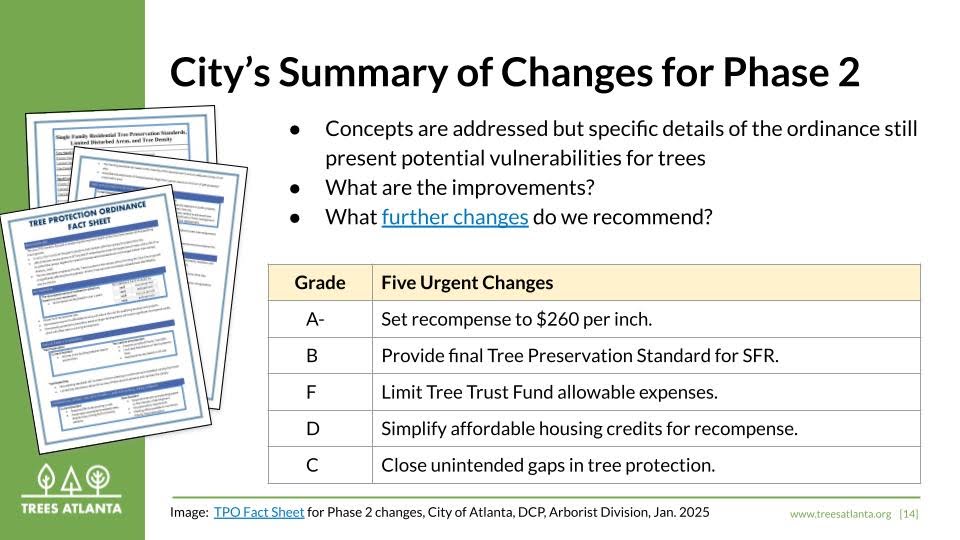
Summary of items receiving poor grades
- Keep the TTF for trees. The Tree Trust Fund (TTF) holds the revenue for trees removed and not replanted. New staffing expenses of approximately $1 to $1.5 million have been inserted to pull from the TTF. This could deplete the TTF and deprive our ability to purchase forested land (e.g., Lake Charlotte, a 215 acre forest, was acquired using TTF in 2021). The TTF should fund the restoration and preservation of our tree canopy. A cap (20%) should be placed on expenses related to the administration of the TPO. The cost of tree inventory, replanting, and land values continues to escalate rapidly. The best strategy is to keep existing trees, but to do the next best thing we must have the funds to restore the tree canopy.
- Tie recompense waivers in proportion to the share of affordable housing in the project. Increasing the number of affordable housing units in Atlanta is a high priority, as is protecting trees for the benefit of all people. To achieve alignment in both common good, discounts for recompense fees should be offered when more affordable housing is provided. Inserted into the TPO are complex rules for affordable housing that gives 50% or 100% waivers of tree recompense fees that are disportionate to the share of affordable housing provided. We urge the city to adjust the discounts so that it ties proportional discounts for more affordability and lowers the risk of excessive tree destruction in communities that deserve to benefit from mature trees.
- Allow the City to pay recompense to the TTF to ensure trees are being replanted. The City requested relief from the current inch-per-inch replanting requirement. It was granted in the TPO. However, the Parks Department has inserted a new “offset credit” plan that would allow it to bypass payment of recompense. We recommend the city be allowed to pay recompense to the TTF rather create a complex new system to be used by the Parks Department. The offset system for public trees diverts funding to replant trees and does not provide funds to the TTF. The city should replant at least one tree for each tree removed, then pay the balance as a recompense fee to the TTF, thus allowing the public to receive total inches replanted elsewhere in the city or reinvest the fee to purchasing forested land and protect existing trees.
- Restore protections that worked in the existing TPO. The 10% limit on stream and wetland buffers and the right to appeal tree permits for city projects have been removed, for example. Rules that have worked should be kept in place.
Let’s pass a better TPO for Atlanta: more delays means more trees are lost. We have solutions, let’s make the changes and move forward.
TPO Quick Actions
The Department of City Planning Arborist Division, lead by Commissioner Jahnee Prince, is responsible for the TPO update, administration, and enforcement. The City Council CD/HS committee has the responsibility of reviewing and representing the interests of the communities they represent. The City Council can accepte a substitute TPO, and they vote to reject or approve, then send it to the Mayor.
We have submitted this information included in this article for their consideration.
Do any or all of these actions. We need your voice to speak for the trees. Deadline for your comments is your March NPU meeting or until the City Council schedules a vote. (Unfortunately, no schedules have been published to the public.)
- Contact Department of City Planning Commissioner Jahnee Prince. Her leadership is needed to assign the resources to update and submit a substitute TPO. We need the TPO to include the recommendations provided here, or we need an explanation why they are being excluded.
- Contact your City Councilmember, Department of Parks & Recreation Commissioner Justin Cutler, and Mayor Dickens. (Contact Info) They need to know this issue matters to you. Tell them if you are concerned abou the gaps in tree protection and if you support Trees Atlanta’s recommendations.
- Attend the next meeting of the Community Development/Human Services (CD/HS) Committee. This committee of City Councilmembers assigned to the TPO update. Their recommendations get sent to the full City Council and then the Mayor for approval. The CD/HS March public meetings are scheduled at 1:30 pm on Tuesday, March 11 and March 25.
- Attend your March NPU meeting and ask your NPU reps: “Who is collecting and submitting feedback on the January draft of the TPO?” The updated TPO has been sent to NPUs to be reviewed by residents and neighborhood groups for comment. Offer the information presented in this article.
What’s the Zoning issue we are asked to vote on at NPU?
Vote no or defer the vote on “Z-25-04: Administrative Variance”. A “companion” zoning administrative variance change has been sent to NPUs to review and vote at February and March meetings. This is a separate ZONING ordinance. It should not to be confused with the TPO. Deadline for your comments and vote is your March NPU meeting.
An administrative variance eliminates the community review requirement. A city arborist can approve a zoning variance to move a building into the setback if the requirements of the variance is met. As written, the requirements are inadequate. For this change to be a positive step, the TPO must first be passed with the recommended changes. The amendment should be resubmitted with corrections and voted on after the TPO is passed.
- Clarify the Administrative Zoning Variance to limit how it can be used (Z-25-04: Administrative Variance).
Essential clarifying language have been promised, but not been provided to NPUs. The necessary change requires the addition of “Priority Tree” as the protected class of trees, but this class does not exist until the TPO is passed. Without the new TPO approved, the administrative zoning variance will be triggered when trees of any species or size at 6″ DBH can be saved by encroaching any setback on the propety. The setback that can be encroached should be limited to sideyard setbacks only.
Webinar Material and City Contacts
The benefit of trees is scientifically proven. Our trees help to defend our city from the negative effects of climate change and increasing heat island effects in the city. The TPO can help to limit tree destruction, reverse tree canopy loss, and preserve our unique and valuable natural resource. We have a valuable asset to leverage for the long-term resilence and well-being of our city.
Please contact your City Councilmembers and city leaders today. Comments are only being accepted this month (March 2025).
- View recording of Feb. 25 Webinar overview of recommendations (60 minutes)
- Presentation slides with active links
- Answers to Submitted Questions
- Contact City Leaders, includes emails and phone numbers
It’s Almost Ready for a “Yes” – Close the Gaps
Trees Atlanta and the tree advocacy community are committed to moving the process forward so that an improved Tree Protection Ordinance for Atlanta can be adopted as quickly as possible. Continued delay results in further decline of our tree canopy. There are several positive changes included in the draft TPO distributed on January 30, 2025, but there remain a few new provisions that were inserted that we have identified as issues that require some adjustments prior to approval.
We believe it is possible to amend some remaining provisions in the TPO to close the gaps that create potential risks to trees. We recommend a substitute ordinance that incorporate these recommendations and have submitted mark ups to the city.
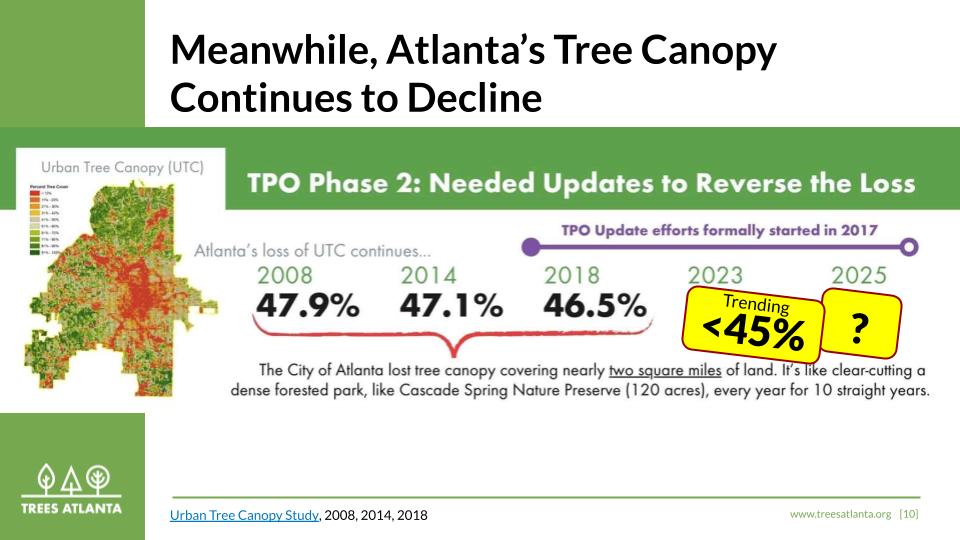
In 2008, our trees shaded 47.9% of the city. We predict that when the 2023 canopy is released soon, our tree cover will be below 45%.
Posted on: March 5, 2025


