Urban Trees Under Pressure: Invasive Pests in Atlanta
Written by Angela McTigue, Trees Atlanta Plant Health Care Supervisor
Trees along our streets and in our parks are part of daily life in Atlanta. Sometimes their branches get in our way and need to be pruned, and in the winter, their leaves fall, making the streets messy for a little while. But in the spring, those branches provide a resting spot for bird nests filled with eggs, and in the summer, they shade our walks and make the heat a little more manageable.
We plant trees for birds, insects, people, and our collective future. A city without trees would be hotter, less vibrant, and ecologically diminished. But urban environments are hard on trees. Heat islands, compacted soils, impervious surfaces, vehicle damage, high foot traffic, and pollution all create stress. One significant threat our trees face is insect pests, especially invasive ones.
What Is A Pest?
In arboriculture, a pest is any organism that negatively impacts the health of the tree. Pests can be native or non-native.
Most commonly, when we refer to tree pests, we are talking about insects, but not all insects that live and feed on a tree are pests. Most don’t cause enough damage to the tree to harm its health. An insect becomes a problem when:
- A tree has other underlying health issues
- Insect populations grow too large
- The type of damage the insect does is detrimental to the tree’s ability to function
One way insects are categorized is by their mouthparts. The type of mouthpart an insect has and how it ingests plant material help us understand the type of damage to expect from the insects. There are two primary “pest” categories of insects: those with chewing mouthparts and those with piercing/sucking mouthparts.
Insects with chewing mouthparts include borers, which are insects that are able to eat holes and channels into the bark and wood of trees. There are also defoliating insects that use their chewing mouthparts to eat part or all of the leaf, like a caterpillar.
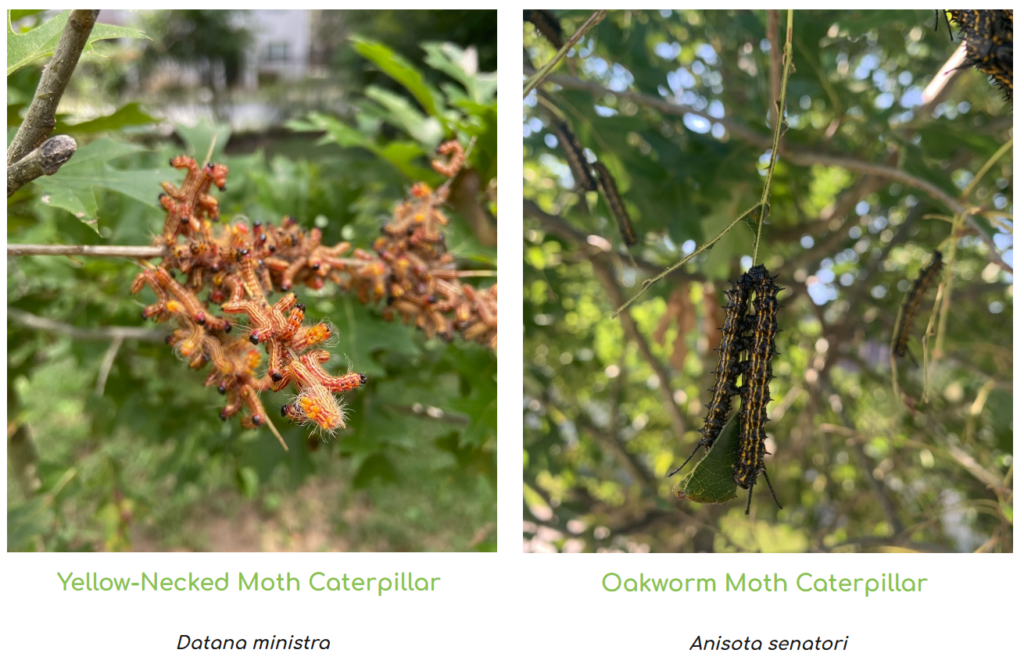
Photo credit: Angela McTigue. Two examples of native defoliating caterpillars. In both photos, you can see how the caterpillars ate the entire foliage of the leaves, leaving the stems.
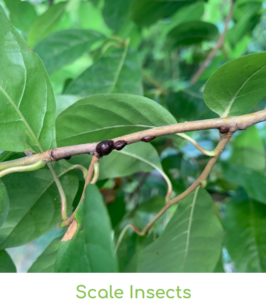 Insects with piercing/sucking mouthparts use their mouth to pierce through plant tissue, like bark or leaves, and suck sap or other liquids from the tissue. Scales are an example of insects with these types of mouthparts.
Photo credit: Angela McTigue. Here is an example of a few scale insects on a Blackgum tree’s branch. The scales are the dark brown lumps on the twig. Each lump is a beetle insect that is immobile and has its piercing mouthparts punctured into the twig to suck the sap. There are thousands of species of scale insects, and many of them are specialists for a particular genus or species of plants.
As mentioned in the previous blog post, How Forest Restoration Supports Wildlife in Atlanta, insects are consumers and specialists. Insect specialists have evolved alongside native plants, developing ways to feed on them without completely overwhelming them. At the same time, native trees evolved defense mechanisms to tolerate and compartmentalize that damage.
Problems arise when an insect is introduced to a new region where trees have not evolved defenses against it. Without natural resistance, damage can be severe. That is when a non-native species becomes invasive.
Understanding the Difference Between Native, Non-native, and Invasive
There are many pests, both native and non-native, in Atlanta. Some of the non-native pests are invasive. Here’s what each of those terms means:
- Native: Indigenous to the ecosystem that it is presently living in.
- Non-native: Not indigenous to the ecosystem that it is presently living in.
- Invasive: Not indigenous to the ecosystem that it is presently living in and causing damage to the ecosystem by outcompeting native organisms.
A Major Threat in Atlanta: Emerald Ash Borer
A key example of how detrimental invasive pests can be to a city and ecosystem is the case of the emerald ash borer (Agrilus planipennis), commonly known as EAB.
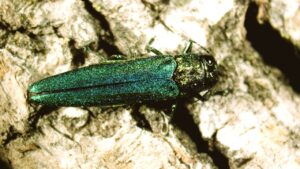 EAB is a small, metallic green beetle native to Japan, Korea, China, Taiwan, and Russia. It was first found in the United States in 2002 in Michigan, likely introduced through hardwood packing materials used in international shipping. From there, it spread further within the U.S. through the timber trade and the movement of firewood.
Now, billions of ash trees across North America are at risk.
Photo credit: USDA. Emerald ash borer on tree bark, retrieved at https://www.aphis.usda.gov/plant-pests-diseases/eab
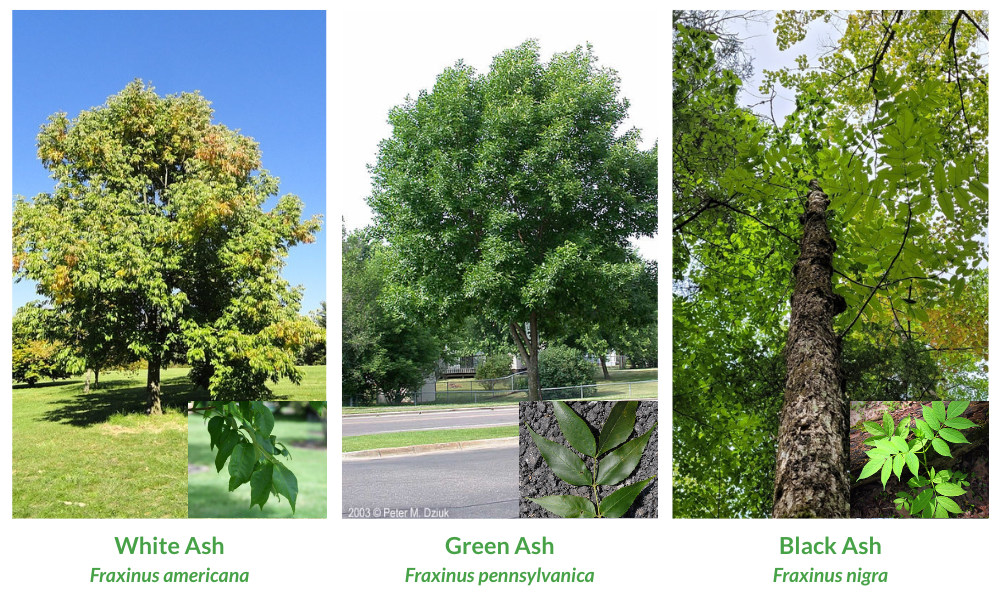
EAB attacks all ash species (Fraxinus spp.), including:
- White Ash (Fraxinus americana)
- Green Ash (Fraxinus pennsylvanica)
- Black Ash (Fraxinus nigra)
How EAB Kills Ash Trees
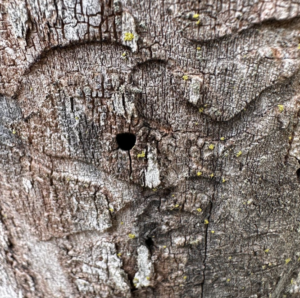 The lifecycle of the emerald ash borer makes the beetle particularly good at killing ash trees native to the U.S. In EAB’s native regions of Eurasia, they also feed on, reproduce in, and rely on the ash trees native to that region. The ash trees in their native habitat have evolved a resistance to the damaging channels the larvae carve out, where the ash tree can compartmentalize faster within its cambium. This allows the tunnels that EAB larvae chew to be more controlled by the trees, and less damaging.
Photo credit: Angela McTigue. An example of an EAB exit hole and the galleries that the larvae tunneled.
Ash trees native to the U.S. don’t have this same evolutionary resistance, since EAB was only introduced to them less than 30 years ago. Eight billion ash trees are at risk of mortality from EAB infestations, including those within forests, lining our streets, and making up the canopy in our parks.
Losing street trees is a big deal. For example, a study in Cincinnati, Ohio, measured the social consequences of losing ash trees to EAB within the city. They found that an increase in crime occurred on streets where EAB infestations increased, and ash tree canopy decreased. Research studies show again and again that the presence of overstory trees in neighborhoods correlates with a reduced crime rate, even when controlled for socioeconomic differences between neighborhoods. You can learn more about the study, The association between urban trees and crime: Evidence from the spread of the emerald ash borer in Cincinnati, and its results here.
Below is a diagram of the EAB lifecycle from the USDA. Adults lay eggs on healthy ash trees. The eggs hatch and the larvae feed on the cambium (the growing part of the trunk), creating galleries, or tunnels, throughout the living tissues of the tree. These galleries affect the tree’s ability to transport water and nutrients from the roots to the canopy. When access to nutrients is cut off, the tree becomes stressed and can die in a matter of years if left untreated.
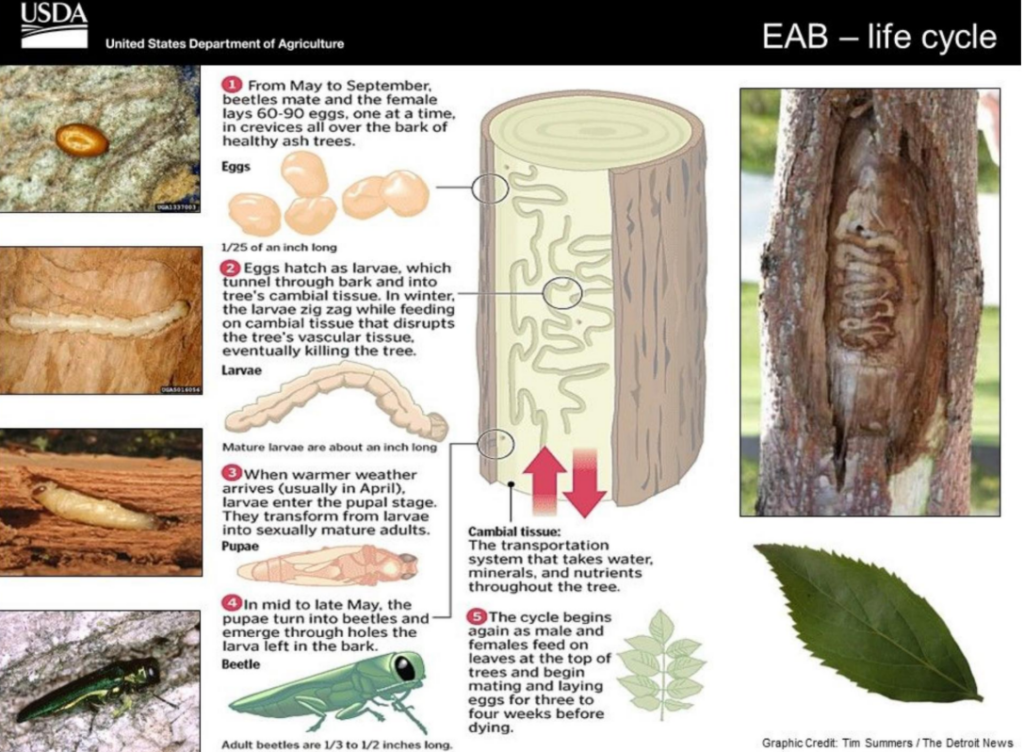
Photo credit: APHIS. USDA. (n.d.). EAB in the United States. Story map retrieved from: www.aphis.usda.gov/aphis/maps/plant-health/eab-storymap.
Preventing The Spread
You can help prevent the spread and severity of EAB on local ash trees.
Burn It Where You Buy It
Never transport firewood more than 50 miles from where it was cut. Always purchase firewood near where you plan to burn it and leave unused wood on site.
Early Detection and Treatment
Early detection is critical. Discovering an infestation and treating it with either preventative or reactionary treatments is important.
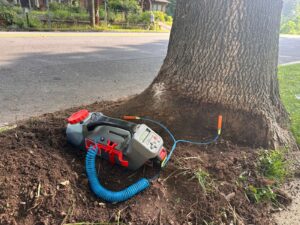 Insecticides can be injected into the trees to effectively poison the cambium, so when larvae start to eat the poisoned tissue, they die. There are a few different insecticide chemicals and modes of injection on the market. The type of insecticide determines the treatment schedule, but many insecticides call for an early spring treatment every other year. The chemical stays within the tree for two years, and treatment in the spring is important due to EAB’s lifecycle. Treating before the larvae hatch and begin eating the cambium is critical.
This kind of treatment should only be done by licensed professionals, local arborist companies, and other organizations that are equipped to complete this work.
Trees Atlanta’s Plant Health Care team treats ash trees throughout the Atlanta area for EAB by using a computerized machine to drill and inject the insecticide into the tree at the base. The tree then pulls the insecticide up through its cambium and is protected from the EAB chewing and creating galleries.
Trees Atlanta currently treats about 150 ash trees and is hoping to expand the program to protect more ash trees throughout metro Atlanta. If you are interested in learning more about the EAB program at Trees Atlanta or adding your ash trees to the list of trees that Trees Atlanta treats, please reach out! If you want to learn more about EAB, there is an EAB Network with more information.
Photo credit: Angela McTigue. Machine used by Trees Atlanta for EAB treatments. Here you can see the nozzles of the machine inserted into the base of the trees, and the blue-dyed insecticide is being pulled into the tree via transpiration.
Looking Ahead
Emerald Ash Borers are only one example of how invasive pests threaten our urban forest. As global trade and the movement of goods increase, new pests will continue to arrive.
Catching infestation early and responding quickly is essential to keeping trees healthy and standing for as long as possible. Atlanta’s identity as the “City in the Forest” depends on proactive stewardship. Protecting our canopy requires awareness, vigilance, and collection action.
About the Author
 Angela McTigue is the Plant Health Care Supervisor at Trees Atlanta. She is an ISA Certified Arborist and holds a Georgia Pesticide Applicator License. Angela started working at Trees Atlanta in 2022 and has been working on building out the organization’s tree health care program since 2023. She grew up in the Caribbean and in Florida, and went to college for Environmental Studies and Biology. Her favorite things include going camping with friends, dancing to disco music, and pruning street trees.
References
Michelle C. Kondo, SeungHoon Han, Geoffrey H. Donovan, John M. MacDonald, The association between urban trees and crime: Evidence from the spread of the emerald ash borer in Cincinnati, Landscape and Urban Planning, Volume 157, 2017, Pages 193-199,
APHIS. USDA. (2020, December 9). Emerald Ash Borer. Retrieved from www.aphis.usda.gov.
Champion Tree National Register. (2019) Retrieved from www.americanforests.org.
Citizen Potawatomi Nation. (2015, October 23). Gun Lake Potawatomi elder and his family of black ash basket weavers. CPN Public Information Office.
Emerald Ash Borer Information Network. (n.d.) Retrieved from www.emeraldashborer.info. Lucas, D. (2015, August 17). Albany Faces New Foe: Emerald Ash Borer. WAMC.org.
Persad, A, (2016, March 7.) Here’s How to Inspect Your Trees for Emerald Ash Borer. Entomology Today.
Herms, D., McCullough, D., Sadof, C., Smitley, D., Miller, F., and Cranshaw, W. (n.d.). Insecticide options for protecting ash trees from emerald ash borer. North Central IPM Center Bulletin. 3rd Edition.
PDCNR. Pennsylvania Department of Conservation and Natural Resources – Forestry. (2006). Retrieved from www.forestryimages.org.
Michigan Department of Natural Resources Forest Resources Division. (2012). ASH MANAGEMENT: EMERALD ASH BORER.
USDA Forest Service. (2019, July 31). Biological Control of the Emerald Ash Borer. Retrieved from www.nrs.fs.fed.us/disturbance/invasive_species/eab/control_management/biological_control.
Wisconsin’s Emerald Ash Borer Information Source. (n.d.). Retrieved from www.datcpservices.wisconsin.gov/eab/index.jsp.
Published on: March 16, 2026


