
Atlanta's Top Pests and Diseases That Harm Our Urban Trees
Not sure how to identify or treat a pest or disease on your tree? Use this resource to help with identification and treatment options, if needed.
Correctly identifying the issue is key, as not all pests are harmful to trees. The Georgia Forestry Commission offers a wealth of tree care information, FAQs, and the Ask an Arborist program for personalized guidance.
The information below is from the Georgia Forestry Commission and the University of Georgia Extension Office.
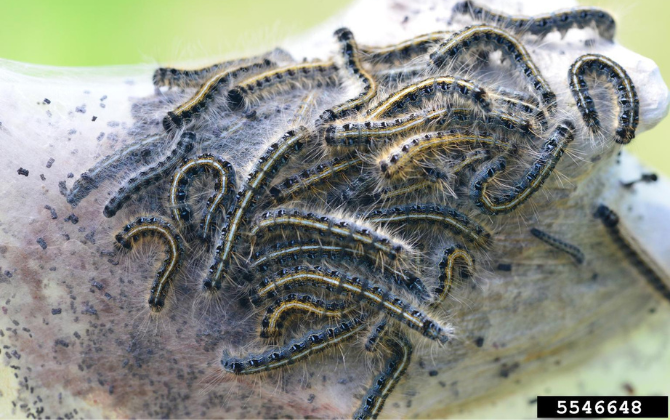


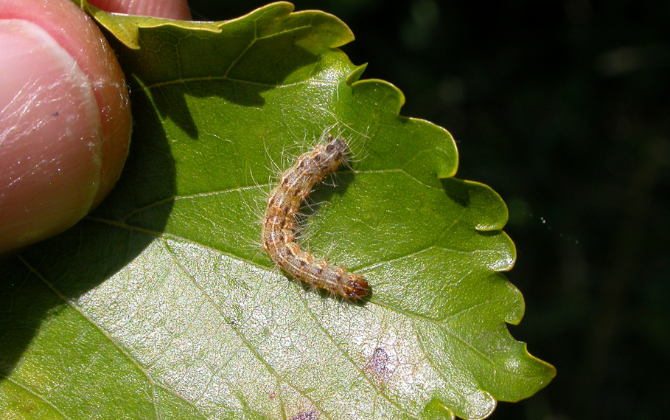

A to Z: Atlanta’s Top Pests and Diseases That Harm Our Urban Trees
Click on a name to jump to its description or scroll.
Notice: Pesticide labels and registrations are subject to frequent revision. Before using any insecticide, refer to the label and confirm that the intended use is in accordance with labels uses and restrictions. See the current edition of the Georgia Post Management Handbook for current control recommendations. The label is the law.
Ambrosia beetles
Host Plants: Oak, pecan, hickory, other ornamental trees and shrubs. Crape myrtle, dogwoods, redbud, and other shade trees.
Control Practices:
(1) Follow proper watering, fertilizing and pruning practices.
(2) Remove other stress factors from trees when possible.
(3) Infested plant material cannot be treated and should be removed and disposed of.
(4) Protect trees from infestation or re-infestation by using products containing bifenthrin or permethrin. Make first application in April and subsequent applications in late May, mid-July and late August.
Learn more about Ambrosia beetles here.
See more images of Ambrosia beetles and Ambrosia beetle evidence here.
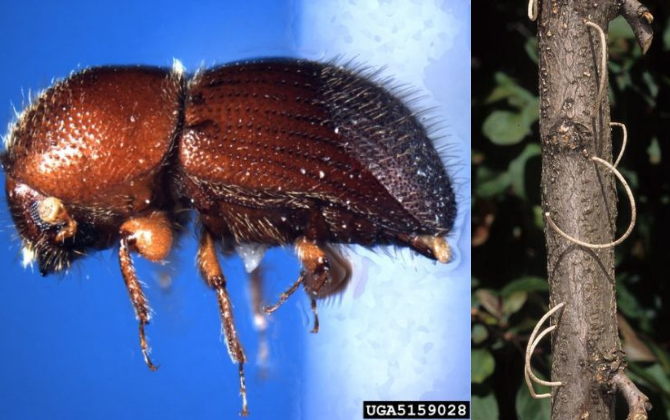
Image credit (L-R): J.R. Baker & S.B. Bambara, North Carolina State University, Bugwood.com; Jim Baker, North Carolina State University, Bugwood.com
Aphids
Host Plants: Many types of shrubs and trees.
Control Practices:
(1) Inspect plants frequently. Look for lady beetles and other beneficial insect populations associated with aphids.
(2) Aphids can be washed off plants with a strong stream of water when populations are light and/or beneficial insects are present.
(3) Avoid applying excessive amounts of high nitrogen fertilizer, which stimulates succulent new growth that aphids prefer to feed on.
(4) When insecticides are needed to control heavy populations, use insecticidal soaps, horticultural oils and products containing acephate (Orthene), malathion, imidacloprid, cyfluthrin or bifenthrin. Follow label directions.
Learn more about aphids here.
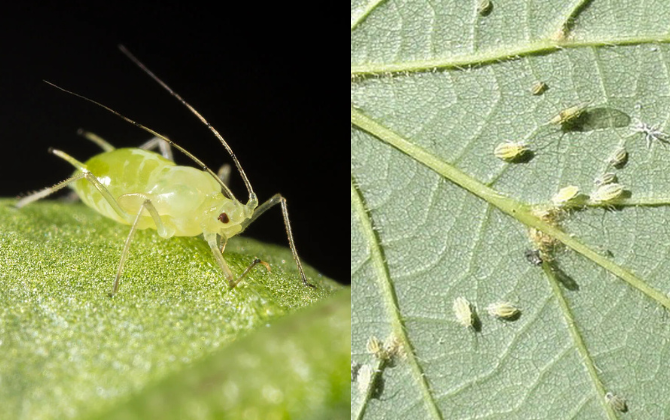
Photo credit (L-R): North American Tree Service; Koppert.com
Elm lead beetle, Willow leaf beetle
Host Plant: Many shade and ornamental trees.
Control Practices:
(1) Inspect trees frequently for beetle damage.
(2) Insecticide applications are most effective when timed for the presence of young larvae or before large numbers of adults are present. Products containing carbaryl (Sevin) or acephate (Orthene) are effective. Repeated applications may be necessary to maintain control when beetles migrate in from surrounding areas.
(3) Protect trees from infestation or re-infestation by using products containing bifenthrin or permethrin. Make first application in April and subsequent applications in late May, mid-July and late August.
See more images of the Elm leaf beetle here.
See more images of the Willow leaf beetle here.
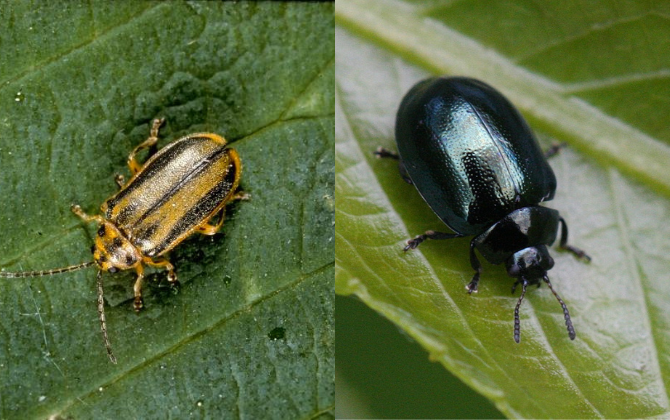
Photo credit (L-R): University of Maryland Extension; David Nicholls, Narborough Bog 01 May 2017
Fall webworms
Host Plant: Plum, peach, apple, hawthorn, oaks, sweet gum, pecan, hickory, other ornamental trees and shrubs. Broadleaf and coniferous trees and shrubs.
Control Practices:
(1) Prune out and destroy webs. Crush caterpillars.
(2) Prior to insecticide treatment, break up webbing material to allow insecticide penetration. Treat webs with products containing acephate (Orthene), Bacillus thuringiensis (Dipel) or carbaryl (Sevin).
Learn more about Fall webworms here.
See more images of Fall webworms here.
Photo credit: Purdue University Extension Entomology
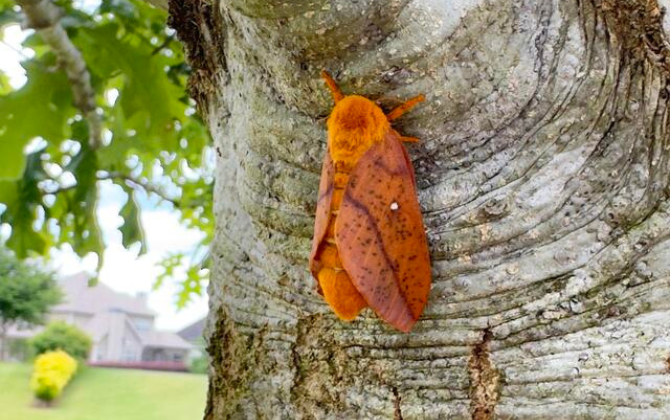
Oakworm moth
Host Plant: Oak
Control Practices:
Oakworm moth caterpillars feed on oak leaves during late summer and early fall. They do not typically harm the tree, unless the tree is already very stressed. No treatment is necessary for Oakworm moths, but if desired, affected branches can be carefully pruned out and caterpillars can be placed near another oak tree.
Learn more about defoliating insects here.
See more images of Oakworm moths here.
Photo credit: Matthewbm2002, Jackson County, GA, June 2025
Pine Beetle
Host Plant: Pine trees
Control Practices:
There are not many treatments for pine beetles that are effective once the tree has been infested. Typically, once the infestation is noticed, the tree is already too damaged for injections and other treatments to be effective. If you suspect your pine tree has a beetle infestation, reach out to a local certified arborist as soon as possible.
Learn more about Pine Beetles here.
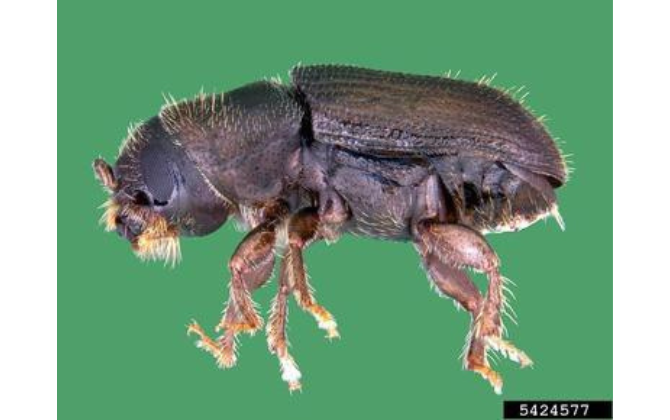
Photo credit: Erich G. Vallery, USDA Forest Service – SRS-4552, Bugwood.com
Scale insects (armored scales, soft scales)
Host Plants: All types of woody ornamentals and trees.
Control Practices:
(1) Select plant material that is not prone to scale infestation.
(2) Inspect plants frequently. Look for lady beetles and other beneficial insect populations associated with scale infestation.
(3) Prune heavily infested plant parts when possible.
(4) Treat infested plants with insecticidal oils during the dormant season or with conventional sprays in spring and summer when young crawlers are actively moving on the plant. Application should cover both sides of leaves and all twigs and branches. Some products labeled for scale control include malathion, acephate (Orthene), carbaryl (Sevin), bifenthrin, cyfluthrin, resmethrin, insecticidal soaps and horticultural oils.
Learn more about the different species of Scale here.
Photo credit: Thompson-morgan.com
Slime flux and Wet wood
Host Plants: Oak, Elm, and Maple
Control Practices:
Weeping “water” from the trunk of a tree is usually a sign of this bacterial disease. The Slime flux attracts insects that like to feed off of the liquid.
Watering and applying light, drip line fertilization can help sustain the tree as it attempts to recover. Washing a bleach and water mixture (1 part bleach to 15 parts water) over the affected areas can help reduce the
amount of fluxing on the surface of the bark. Repeated treatments once a week for four weeks may be necessary. This treatment can be done any time of the year.
Learn more about slime flux/wet wood here.
Photo credit: The Morton Arboretum; Utah State University Plant Health Extension
Spider mites
Host Plants: All types of woody ornamentals and trees.
Control Practices:
(1) Inspect susceptible plants weekly during hot, dry periods for developing mite infestations.
(2) Wash light infestations off the host plant with a strong stream of water.
(3) When possible, remove and destroy heavily infested plant parts.
(4) When chemical control is necessary, use products containing acephate (Orthene), bifenthrin, horticultural oils or insecticidal soaps. Often two to three applications at five- to seven-day intervals are necessary to control heavy populations. Observe and follow label instructions and restrictions.
Learn more about spider mites here.
See more images of spider mites here.
Photo credit: OSU Extension Tulsa County Master Gardeners
Tent caterpillars
Host Plants: Plum, peach, apple. hawthorn, oaks, sweet gum and other trees.
Control Practices:
(1) Inspect trees for egg masses during winter pruning. Remove and destroy egg masses.
(2) Prune out webs when first noticed.
(3) Destroy webs and crush caterpillars.
(4) Time insecticide applications for presence of feeding caterpillars. Spot treat webs with products containing diazinon, Bacillus thuringiensis (Dipel), carbaryl (Sevin) or malathion.
Learn more about Tent caterpillars here and here.
See more images of the Eastern tent caterpillar here.
See more images of the Forest tent caterpillar here.
Photo credit: David L. Clement, University of Maryland, Bugwood.com
Have a pest not listed here? Let us know: treecare@treesatlanta.org.


