Plant a Yard Tree, Grow an Urban Forest
Written by Michael Lupsha, Trees Atlanta Plant Health Care and Front Yard Tree Senior Manager and Hutson Chilton, Trees Atlanta Community Forestry Supervisor
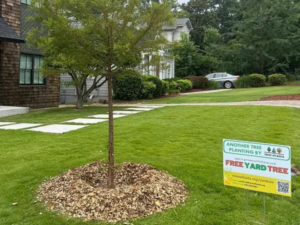
Did I hear free yard trees? You certainly did! Trees Atlanta has a program solely devoted to planting overstory shade trees in your front yard. As a recipient of these trees, you are contributing to improving our urban canopy and helping our city preserve its illustrious title as the ‘City in the Forest’. While Trees Atlanta has planted yard trees within the city since its inception in 1985, it wasn’t until 2017 that a dedicated program was established. Over the past 9 years, the program has branched out and partnered with 11 municipalities, covering all regions of the greater Atlanta area.
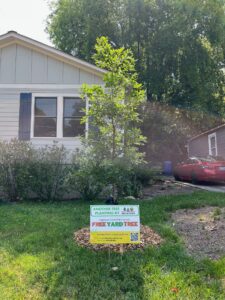
Planting a tree in your yard is one of the most powerful things you can do as an individual to make an impact for your home, your neighborhood, and your local ecosystem.
The majority (72%) of our city’s tree canopy is found on private land, and we are losing about half an acre of forest every day. This loss is in large part driven by redevelopment of single family homes.1 Preserving the trees in your yard when possible – and adding canopy in areas without – is an excellent way to combat this loss.
While we at Trees Atlanta plant in as many public places as we can, (following the “Right Tree, Right Place” principles), the site constraints of streetside locations often require planting understory trees. When the Right Of Way (ROW) space between the sidewalk and street has overhead powerlines, or limited soil volume, we are unable to plant overstory canopy trees. These larger overstory species will provide increased benefits. Compared to a tree with a 6” diameter, a tree with a 30” diameter will provide 10x air pollution interception, store 90x more carbon, and have up to 100x more leaf area for evapotranspiration & shade.2 These canopy trees will also provide these benefits over a longer span of time, as they tend to live much longer than a smaller understory tree.
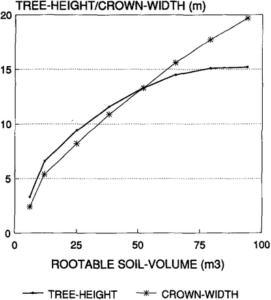
Canopy trees, however, can only reach their benefit potential if they grow to maturity. They need adequate root space to do so. See the below graph from an oft-cited paper showing how reduced soil volume (and therefore reduced water and nutrient intake) prevents trees from growing to their full capacity.3
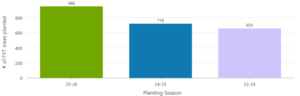
Enter the Trees Atlanta Yard Tree Program! The open space of a yard is much more hospitable to an overstory tree, leading to a tree with greater canopy and a longer lifespan. In the 26-27 planting season, we were able to plant 88% (835 trees) overstory trees through our yard tree program, while only 39.7% (1,958 trees) overstory was possible for project trees in public spaces. This is why we’ve grown the capacity of the yard tree program, planting 200 more trees last year than the year before.
We offer many lovely native species suitable for yards. If you have a smaller yard, we recommend midstory options such as blackgum (Nyssa sylvatica) or Shumard oak (Quercus shumardii), both of which have vibrant fall color.
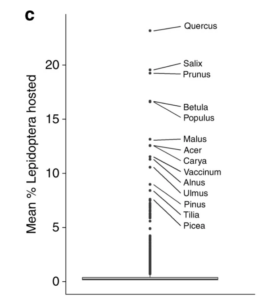
If you have more space, we strongly encourage a white oak (Quercus alba). They are an incredibly long-lived keystone species for our region, hosting 537 species of butterfly & moth caterpillars – which in turn feed many species of birds and other wildlife.4 In fact, oaks (genus Quercus) make up a large portion of the 14% of native plant species that host 90% of caterpillar species in North America5 – see the graph to the right.6
If you have a frequently wet area or are near a creek, river birch (Betula nigra) and bald cypress (Taxodium distichum) are appropriate species. If your yard is heavily shaded, but with enough space to start planning successionally for another overstory tree, the long-lived American beech (Fagus grandifolia) and vibrant red maple (Acer rubrum) are beautiful options.
All of these native tree species will bring many benefits to your home:
- Cooling: Both shade and evapotranspiration provided by the tree reduces energy demands & bills, especially when trees are planted on the south side of your home.
- Stormwater Management: Trees – especially riparian species – can help tremendously with stormwater management and wet spots in your yard.
- Wildlife Habitat: They also provide the basic needs for a wide variety of wildlife, so you can witness the lives of birds, bats, and butterflies right from your home.
- Improved Property Values: On top of all that, mature trees improve property values – making them a good investment not only for the ecosystem but for your wallet!
 Once we’ve planted a tree (or trees) at your home, we strongly encourage you to take our pruning training so that you can ensure the tree has good structure over its first few years of life, leading to a healthy & strong form for its lifetime. If you already have a mature tree at your home that may be hazardous and need pruning or removal, consider applying for Georgia’s Tree Removal Assistance Program or the similar program in DeKalb County for seniors to either extend the life of your tree, or remove and replace your hazardous tree if necessary.
The planting season has just begun – apply for a free yard tree today, and make a difference in your energy bill, local ecosystem, and community with a single free tree!
By getting a tree planted in your yard, you are establishing a green legacy that you and your family can reflect on as you grow together over the years.

 About the Authors
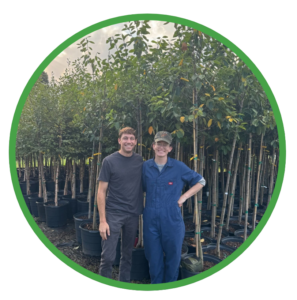
Hutson Chilton was a Green Tee volunteer before applying to work at Trees Atlanta, and has been working here for 4.5 years. They’ve spent the majority of their time in the community forestry department, planting & maintaining trees all over metro Atlanta – and still maintains that planting yard trees is one of the most fun & rewarding jobs at the organization! Outside of work, they skate with Atlanta Roller Derby, compete in speed jigsaw puzzle events, and spend time with their dog Micah.
Michael Lupsha has worked at Trees Atlanta for 5.5 years. He started out as a seasonal technician and then settled into a full time role as a Neighborwoods lead. Since Michael’s early days at Trees Atlanta, he’s continued to foster his passion for trees and community forestry with a focus on the yard tree program. Not only has it been rewarding to plant yard trees to improve the environment and urban canopy, Michael has also enjoyed the opportunity to meet and converse with the many friendly people throughout the City of Atlanta and surrounding municipalities. Michael has recently become co-manager in the Neighborwoods department and has expanded his responsibilities to include developing the plant health care program, ensuring community tree plantings are healthy and can thrive for many years. Outside of work, Michael plays guitar, enjoys live music, goes fishing, and loves trail running with his wife, Becca and dog, Ava.
References:
- City of Atlanta 2023 Canopy Assessment, Georgia Tech Center for Urban Resilience and Analytics, 2026.
- Every Tree Counts: A Portrait of Toronto’s Urban Forest, Toronto Parks, Forestry & Recreation, 2013.
- The Effects of Restricted Volumes of Soil on the Growth and Development of Street Trees, Jitze Kopinga, Agriculture & Urban Forestry, 1991.
- Oaks: The Key to Sustainable Landscaping, Doug Tallamy, 2021.
- Power Plants, National Wildlife Federation, 2022.
- Few keystone plant genera support the majority of Lepidoptera species, Narango, Tallamy, & Shropshire, Nature Communications, 2020.
Published on: November 25, 2026


