Forest Restoration in Legacy Park – Summer 2026 Update
Legacy Park in Decatur, Georgia is a 77-acre public greenspace where we are carefully restoring ecological balance. Trees Atlanta Forest Restoration team and dedicated volunteers work diligently to restore the wooded areas within the park. This includes invasive plant species removal and native tree planting. Trees Atlanta is currently in its fifth year of restoration work at the park.
In this update, let’s look at the seasons of care, review a site visit by Georgia Tech students Carlos and Ella, and meet Legacy Park Forest Steward Co-Leads: Tony Fiore and John McFarland. Read on to see how you can join us at an upcoming volunteer project at Legacy Park.
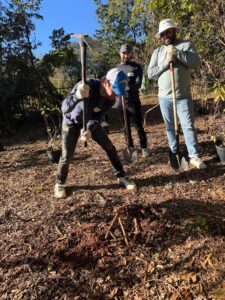 The Winter of ’25
Fall and winter are the best times to plant trees. As temperatures drop, trees go dormant and need fewer resources, making them better equipped to settle into a new home. Moving from a nursery to a forested setting is a big transition for a young tree, and the cooler months give them the breathing room they need to adjust before the demands of spring arrive.
This past season, Legacy Park saw four major planting projects, adding a total of 300 trees and shrubs to the park. With the help of our Green Shirt volunteers, Trees Atlanta put in an array of native species chosen to fruit, flower, and provide food and shelter for wildlife across the ecosystem.
To close canopy gaps in the overstory, we planted oaks (willow, northern red, southern red, and shumard), silver and red maple, sycamore, Eastern red cedar, American persimmon, bald cypress, and more. We also made sure to diversify the forest layers below, adding understory species including silky and flowering dogwood, serviceberry, fringe tree, smooth alder, blackhaw viburnum, and more.
Fun Fact: Oaks are a keystone species, supporting over 400,000 species of wildlife, including insects, birds, mammals, and more!
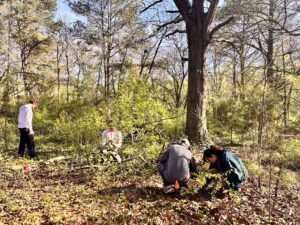 Summertime Sinus
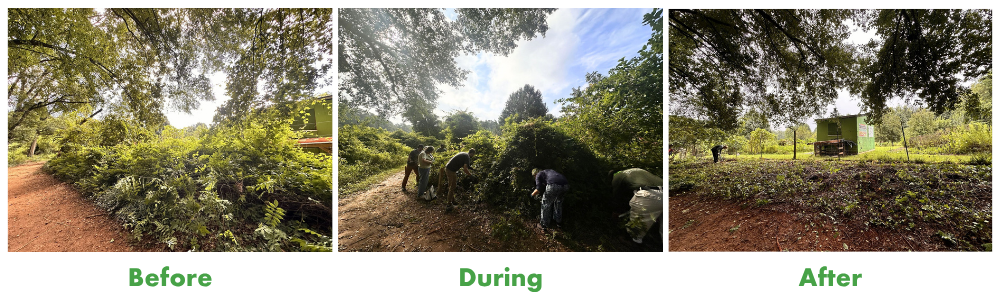
As temperatures rise, plants emerge from dormancy and push out new foliage, and that’s our cue to shift into spring and summer mode. This season, the focus turns to deciduous invasive species: chaff flower, air potato, porcelain vine, wisteria, and kudzu. Climbing vines are cut to kill off what’s growing above ground, followed by either hand-pulling the roots or applying a foliar herbicide to makes sure the plant can’t come back. These species are prioritizing in warmer months simply because that’s what they’re most visible and most vulnerable.
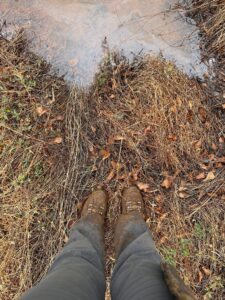 Year-round, cut-and-treat of woody invasive species continues, a method where a cut is made at the base of the plant and a small amount of herbicide is applied directly to attack the root system. And regardless of season, English ivy removal from trees goes on without pause, particularly in areas where herbicide can’t be used: spots that are too wet or too close to the water. A little mud on your boots never hurt anyone!
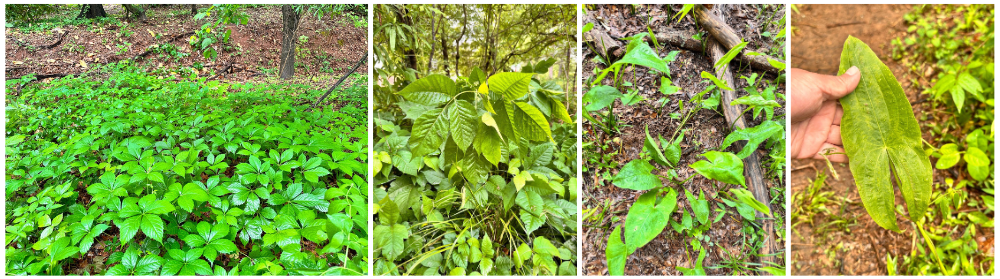
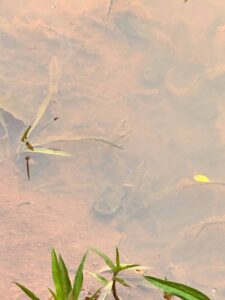
Once English ivy is cleared, native species get their chance to come back. What you’ll often see returning first are native groundcover vines like Virginia creeper and poison ivy. They can look like they’re blanketing the ground too, but there’s enough space between the leaves for other plants to push through toward sunlight. Both are also deciduous, meaning they die back in colder months and open the door for early spring ephemerals to bloom. Along the pond edges, keep an eye our for another native groundcover making its presence known: arrowleaf, or Sagitarria latifolia, a wetland species that thrives in the moist soils where Legacy Park meets the water.
 Seeing the Sights!
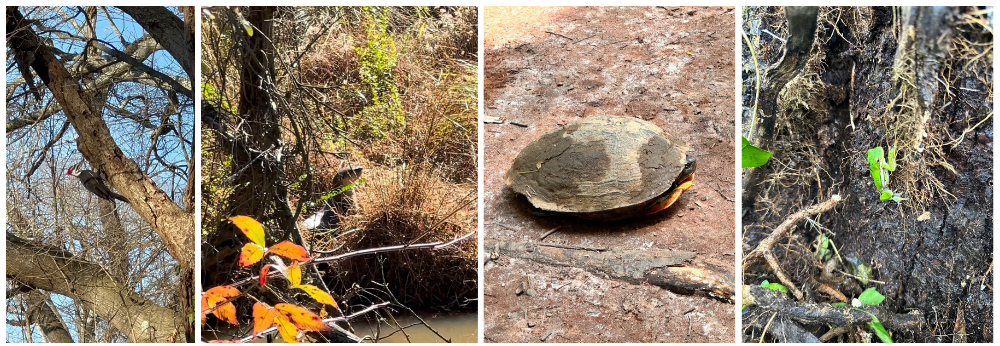
Wildlife at Legacy Park is abundant. Spring and summer bring vegetation back from dormancy, and with it comes a surge of activity from wildlife in the park, from smaller amphibian friends like tadpoles to larger mammals like beavers and otters.
When invasive species are removed, native plants regenerate naturally, making room for biodiversity to take hold. This matters more than it might seem: native birds depend on native insects for proper nutrition, and those insects are only attracted to native plants. Without them, birds can become malnourished, underproduce eggs, and struggle to sustain their populations over time. In a habitat like Legacy Park, that chain of dependency is everything.
The park is a true bird hub, drawing both local and migratory species. Pictured here is a pileated woodpecker, a strict insectivore and a sign of an insect-rich ecosystem. Also making appearances: turtles, frogs, and of course, the always-mysterious otters of Legacy Park.
SHOUT! SHOUT! SHOUT out for the Green Shirt Volunteers!
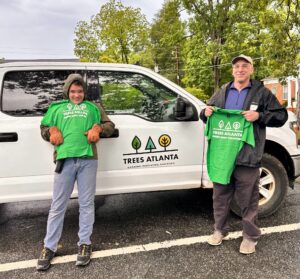
Volunteers are the core of Trees Atlanta. We couldn’t do any of this work without them! Here are some of our frequent flyers at Legacy Park, including a father-and-son duo who showed up for both planting season and invasive removal projects. Not pictured but equally appreciated: Mike, Charles, Bill, and William.
Our Green Shirt volunteers are a vital part of how projects run smoothly. They support project leaders by helping newer volunteer who are still getting the hand of plant ID or tree planting. This is especially important with larger groups. Green Shirts understand the flow of a project and can also sign up as Project Ambassadors, stepping into a more formal support role that includes helping with sign-ins, guiding volunteers to the right location, and more.
 Speaking of large groups, bring your coworkers!
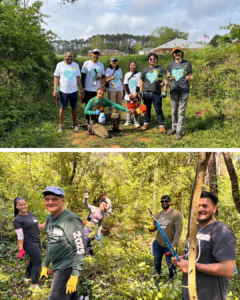
Trees Atlanta regularly welcomes corporate volunteer groups, who get to experience what restoration work actually looks like while also getting in some genuinely good team building. In a 77-acre park, big groups make a real difference, covering ground in hours that might otherwise take months.
That was on full display during our annual Conserve the 4-0-Forest event, where Trees Atlanta hosted volunteers across 13 green spaces in metro Atlanta to remove invasive plants. Legacy Park was one of those sites. Volunteers tackled three separate areas in need of removal and still had time for an educational tour of the park. The ecological ripple effect of that work is real, and volunteers are the ones who help set it in motion.
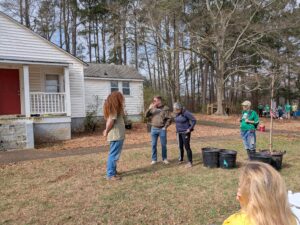 A Day Celebrating Community Forestry
This March, Trees Atlanta Community Forestry Coordinator Todd Wiggins worked with Decatur Community Habitat, Legacy Decatur, and the City of Decatur to host a Community Forestry Day in Legacy Park. This event helped engage, educate, and empower community members about the importance of trees. The day included a series of expert presentations from local experts, tabling from local environmental organizations, a tree giveaway, and more! Stay tuned for our next Community Forestry Day.
How to Get Involved
Get involved with Legacy Park restoration! Invasive removal projects are held every second and fourth Saturday of the month. Friday projects are led by our incredible Forest Stewards. Volunteer at these upcoming projects:
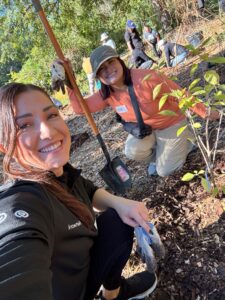 Saturday Projects (9am – 12pm)
Friday Projects (8am – 11am, Led by Forest Stewards)
Storytelling with Georgia Tech
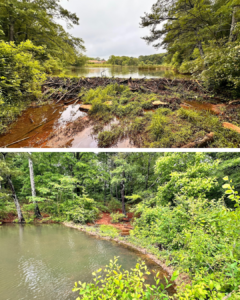
Georgia Tech students Carlos Sanchez and Ella Dale took time to speak with Forest Restoration Coordinator Vicki Mendez about Trees Atlanta’s work at Legacy Park and why restoration matters in green spaces like this one. The students got to experience restoration firsthand, both the physical labor while volunteering and exploring the signs of regeneration that follow invasive species removal on a tour of the park.
Restoration is not linear. Some areas of the park hold denser patches of invasive species than others, while some already show more native groundcover returning. On a tour with Vicki, the students got the explore both. They saw wisteria and English ivy in areas where these species have persisted for years and will take many more the bring down to a manageable density. But where removal has taken place, oak saplings are emerging and Virginia creeper is spreading, providing native food sources for wildlife.
The students also encountered signs of beaver activity. They walked the many dams of Legacy Park and learned how beavers function as keystone species. They are nature’s engineers, reshaping the landscape and drawing in wetland species. Beavers instinctively dam near their dens, locking in resources and creating a natural terracing effect. Sediment settles in, vegetation follows, and those fragments of native plants begin attracting the insects and other resources that local and migratory birds rely on. While beavers are still considered an nuisance in some contexts, their presence at Legacy Park tells a different story about the ecological benefits for a wide range of flora and fauna.
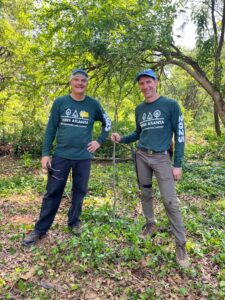 Legacy Park Forest Steward Co-Leads: Tony Fiore and John McFarland
Certified Forest Stewards John McFarland and Tony Fiore are an instrumental part of Trees Atlanta’s restoration work at Legacy Park. After completing Trees Atlanta’s Forest Stewardship program and many hours of hands on work, they’re equipped to teach volunteers about invasive species, lead removal projects, and apply their knowledge of safe herbicide use when needed.
Every planting project at Legacy Park begins with a pre-planting project to prepare the site. That means slinging mulch buckets, hauling 100+ trees to a planting area, and conducing invasive removal first. John and Tony led volunteers through dense thickets of wisteria using the cut-and-treat method, clearing the way for what came next.
Thank you John and Tony, for your hard work, your dedication, and your genuine love for this work. It shows!
Forest Stewards play a vital role in extending restoration efforts across Atlanta’s green spaces. Learn how you can become a Forest Steward at treesatlanta.org/forest-steward.
 About The Author: Vicki Mendez
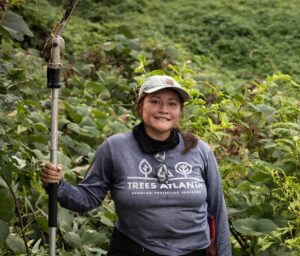
Vicki Mendez is a Forest Restoration Coordinator at Trees Atlanta and an ISA Certified Arborist. As a Georgia State University graduate with a Bachelor of Science, she has always been passionate about wildlife and environmental conservation. She has been with Trees Atlanta for four years, having started as a Forestry Technician before assuming her current role. She helps oversee the restoration of green spaces in the City of Atlanta, Decatur, and College Park.
“Over the past year, I have put a lot of time into this park. My love for the green space is within my interactions with people, the work that I do, and connections I make. From the bottom of my heart, I would like to thank everyone for showing up for your community and your local green spaces, from our volunteers to the inquisitive passersby. It is an honor to work with the passionate individuals who oversee Legacy Park, Legacy Decatur, and City of Decatur. I hope to see you at an upcoming project!”
Published on June 30, 2026


